This article was originally published by The Lawyer’s Daily, (www.thelawyersdaily.ca) a division of LexisNexis Canada.
You can read the full article here:
https://www.thelawyersdaily.ca/articles/42047/-why-55-000-lawyers-need-five-trees
Why 55,000 lawyers need five trees

Monday, December 05, 2022 @ 3:13 PM | By Anita Szigeti
 “> “> |
| Anita Szigeti |
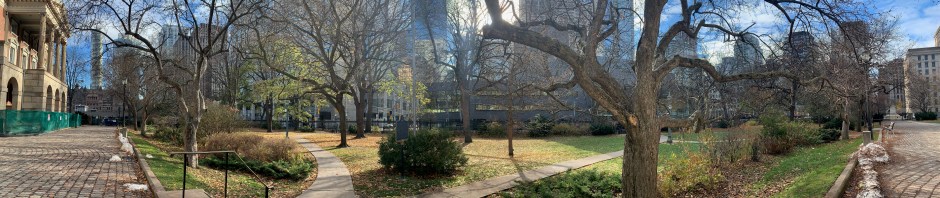
When I first heard that Metrolinx was planning to cut down five of the 200-year-old trees in the Heritage Gardens of Osgoode Hall, I saw red. I mean my blood pressure rose, I got angry and very nearly cried. That reaction shocked me, because I’ve never thought of myself as particularly engaged with nature. People who know me well would never think of trees as first and foremost among my loves. Baseball, coffee, dogs and a long list of things I can obsess about, well before trees.
But one thing I cannot countenance is unfairness. Injustice and broken promises don’t sit well with lawyers generally. And here, Metrolinx was about to break their promise. They had agreed to wait for an independent assessment of alternative approaches to their construction that didn’t involve destroying any part of this special space. Then they didn’t wait and threatened to start killing the first five trees on just a few days’ notice instead. This was never going to go unanswered by Ontario’s 55,000-plus lawyers. And it didn’t.
Many individual Ontario lawyers and various law associations protested on social media and by writing thoughtful and compelling letters, making the case for the trees. The Law Society Ontario (LSO) took to mainstream media. A few hundred people tied ribbons around the trees announcing their heritage protection. And I started packing a little bag of water bottle, blanket, supplies, to go down and tie myself to a tree, if it came to that. Quite a few of my colleagues were prepared to join in solidarity. We imagined rows of robed and tabbed counsel forming protective circles around our trees. Answering the apparently age-old question: “should trees have lawyers?” We might as well have been retained.
What is it about these old trees in the gardens of Ontario’s top court that drew such impassioned reactions from our profession? Much of their history and meaning is set out by the law society, which on Dec. 1, 2022, passed a formal motion to oppose expropriation by Metrolinx. You can learn about what these trees have survived in their more than 200 years on the grounds of Osgoode Hall, and take in-person or virtual and audio tours of the building and gardens. But what was it about the tranquil gardens and the imperilled trees in particular that tugged at our collective heartstrings to light such a fire under the profession?
I think it has a lot to do with what lawyers have lost as a result of COVID. Before the pandemic, courthouses were all bustling places, with lawyers’ lounges filled with chatter, robed colleagues, law students, harried before court, relaxing afterwards, constantly interacting, mentoring, sharing anecdotes, supporting one another. Then came the great ghost-town period where all in person interactions completely shut down, and we went 100 per cent virtual out of necessity.
The practising bar lost so much in the process. We have suffered a global trauma that has adversely affected lawyers, along with everyone else. This is not to suggest there are not greater losses, tragedies, public health emergencies that older adults, and now children, are facing every day, as a result of the virus. Without minimizing any much more significant losses, I do think it appropriate to point out that the legal profession has had a hard time with the isolation and alienation that virtual litigation has brought us as it replaced so much of our daily professional lives and human connections.
And even while some things are returning in person, including in the Court of Appeal, things are hardly back to “normal.” Many counsel and parties still choose to appear virtually — I was in the court a couple of weeks ago, and I was the only lawyer in the courtroom in person, throughout several hearings, for example. And even when we do gather, there is a residual and lingering anxiety around being potentially exposed to illness that many of us just can’t shake. And the future is always uncertain. Any day now we could face another lockdown or revert to the necessity of exclusively virtual proceedings.
Throughout all of this, and for the long while we couldn’t gather indoors at all, what has saved us was access to the outdoors. Outdoor spaces took on a new significance. We all started to spruce up our backyards and bring our balconies to life. Parks got as much traffic as they could handle, where kids could breathe and run around with friends. The gardens at Osgoode Hall, having enveloped the stunning architectural beauty of the building itself for centuries, provided a steady and comforting space, where we could walk and sit to contemplate.
While so many of the other rituals those of us who appear regularly in the court were lost to us during COVID, the gardens never left us. For ages the law society section of the building was closed off altogether, preventing access to robing rooms and the one working elevator. The famed restaurant upstairs, a staple in the lives of appellate lawyers forever, was permanently closed ultimately, a sad and crushing loss for many. Even the great library, probably the most beautiful room in Toronto, was closed to in- person use for an extended period.
Throughout all of that, the gardens were there. And that is where I sat before and after every appeal. I had always cut through the grounds to get to court, appearing in the court for my 30 years at the bar. I recall many fond conversations with justices as they came and went to get coffee or returned from lunch for the afternoon session. I remember standing outside smoking cigarettes nervously before an outing, back when. But it’s only during the last three years that I have really taken to sitting and watching the garden and its visitors.
The trees are massive and stunning. The benches just outside the entrance to the court are under a couple of giant cherry blossoms. This summer I got hit on the head by a falling cherry. It hurt more than you’d think, but I didn’t mind a bit. It made me smile. I sat there before or after an appeal, or most likely both, watching people walking their dogs, kids and families admiring the gardens, taking selfies with the trees. The incredible tulip gardens in the spring, brightening our day with their dazzling array of bright, warm shades of yellow, pink, red and purple. All under the canopy and shade of these wise old trees.
Appearing in the Court of Appeal for Ontario is a nerve-wracking experience. Even while I have been privileged to do so more than 200 times in my career and still do so regularly, no case comes without the weighty burden of knowing how much turns on it for my client. There is generally nowhere to go from here — but for the rare occasion the Supreme Court may grant leave. Win or lose in this court and a person’s freedom for life can depend on how you do in that courtroom. Sitting quietly under the trees we very nearly just lost for no reason is a safe haven for me and I suspect many others. It’s a place to breathe, take stock, calm down and get battle ready for what’s to come. It’s a place to unwind, settle and clear our heads in the wake of an appeal just argued. It’s a sacred place for self-reflection and to bring us out of our heads, into the real world.
The trees in Osgoode’s Heritage Gardens have been there before us and have been there for us throughout the pandemic. They must be kept safe for generations of lawyers and for the public yet to come, well after us. It would be best if Metrolinx, now having realized no trees need be lost for its archeological assessment after all, just left the trees alone permanently. But if it doesn’t, Ontario’s 55,000 lawyers are ready. We are here for the trees in their time of need, as they have been here for us, when we needed them.
Anita Szigeti is the principal lawyer at Anita Szigeti Advocates, a boutique Toronto law firm specializing in mental health justice litigation. She is the founder of two national volunteer lawyer associations: the Law and Mental Disorder Association and Women in Canadian Criminal Defence. Find her on LinkedIn, follow her on Twitter and on her blog.
The opinions expressed are those of the author(s) and do not necessarily reflect the views of the author’s firm, its clients, The Lawyer’s Daily, LexisNexis Canada, or any of its or their respective affiliates. This article is for general information purposes and is not intended to be and should not be taken as legal advice.
Photo credit / studiogstock STOCKPHOTO.COM
Interested in writing for us? To learn more about how you can add your voice to The Lawyer’s Daily, contact Analysis Editor Peter Carter at peter.carter@lexisnexis.ca or call 647-776-6740.


 anitaszigeti
Pingback: It was the best of times, it was the worst of times – 2022 recap – Anita’s year-end review December 23, 2022 | anitaszigeti