
Toronto man held in psychiatric ‘seclusion’ for 20 years must be reassessed, court rules. ‘He’s still that same person inside,’ says his sister
Camelott Hamblett is “not some monster,” his sister told the Star. “He just has a mental illness that needs to be treated.”
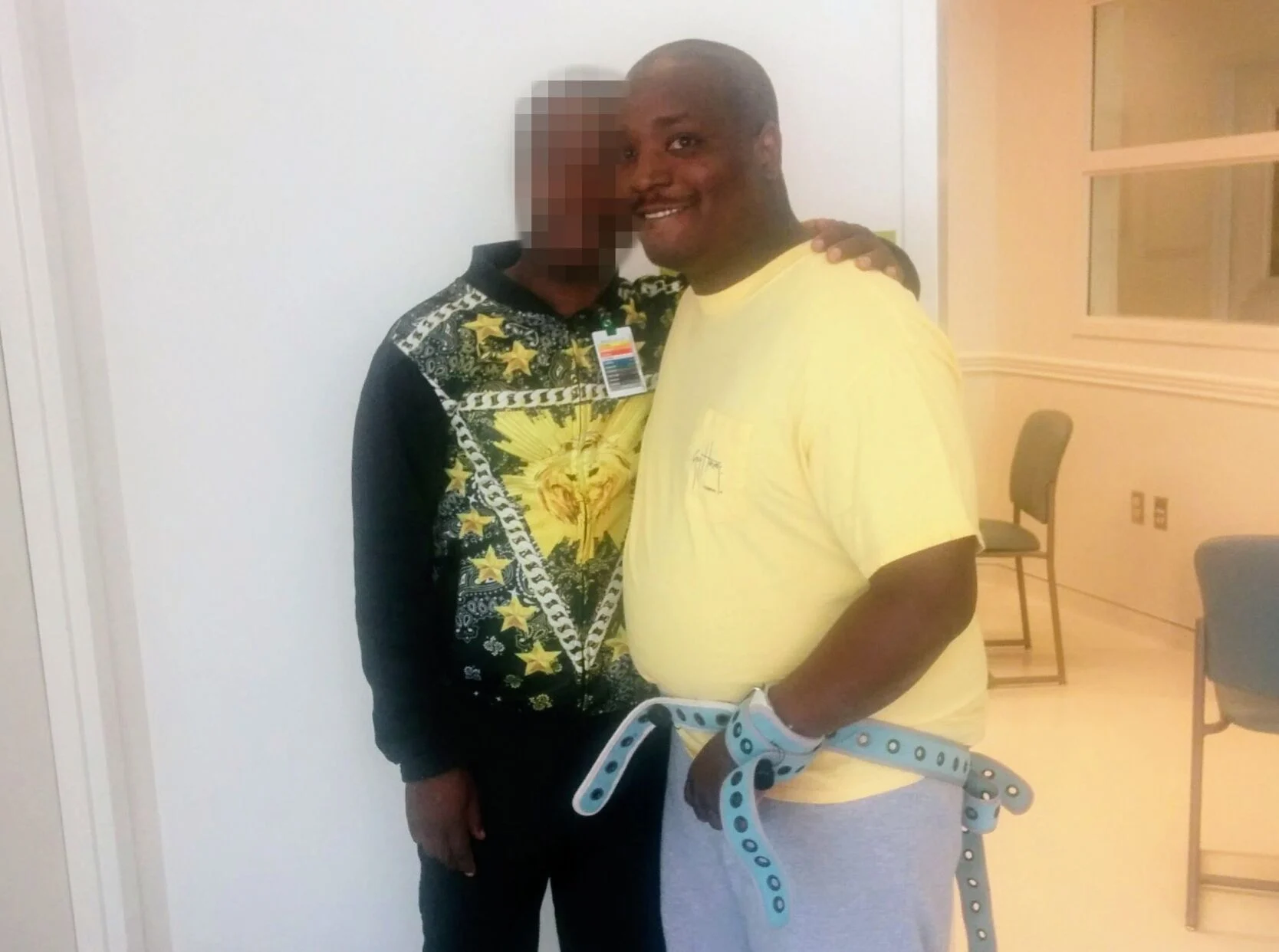
Camelott Hamblett, right, poses with a relative at Waypoint Centre for Mental Health Care in 2015. Supplied/Cheyenne Phillip

By Jacques GallantCourts and Justice Reporter
Two years ago, Cheyenne Phillip said she spoke to the psychiatric hospital where her brother has been locked in near-total isolation for 20 years and asked:
“When do you guys plan on returning him? When he’s in a box?”
As the Star first reported Monday, Phillip’s older brother, 43-year-old Toronto man Camelott Hamblett, has never been let out of his room at Waypoint Centre for Mental Health Care for more than two hours a day — some days much less, others not at all — and usually in restraints. Diagnosed with treatment-resistant schizophrenia and found not criminally responsible for a 2004 sexual assault, Hamblett has been kept in what is known as seclusion due to aggressive behaviour triggered by persistent hallucinations.
He was finally offered a glimmer of hope on Friday, after the Ontario Court of Appeal ordered an independent medical assessment of his case, as requested by Hamblett’s lawyer, Anita Szigeti, in the hopes that it would lead to Hamblett being released from isolation.
Star Exclusive
For 20 years, this man has been locked in ‘seclusion’ at an Ontario psychiatric hospital. ‘Somebody has to care,’ his lawyer says
“No meaningful progress has been made with his treatment, and there appears to be no real prospect of his situation improving,” wrote Justice Grant Huscroft for a unanimous three-judge panel. “The hospital expressed little confidence that any progress will be made. The best that can be said for the hospital’s position is that there remain things it can try, and that the appellant could possibly make some progress.
“After 20 years, this will not do.”
Phillip told the Star in an interview Friday that the decision came as a relief — “To know that finally people can see what’s going on and people can understand his story, to know that he’s there. Because I feel like he’s been in the dark for so long.”
Waypoint said in a statement that while it can’t comment on individual patient cases, the hospital welcomes the court’s ruling.
“Independent assessments offer valuable perspectives on how to best support individuals with complex and treatment-resistant needs and are already an integral part of Waypoint’s proactive approach to care,” the statement said. “Waypoint remains committed to exploring all avenues to improve the quality of life for patients.”
Why Camelott Hamblett has been in seclusion for 20 years
Hamblett has been detained at Waypoint, next to Georgian Bay in Penetanguishene, Ont., since 2005. He was arrested after chasing a stranger in the street, exposing himself to her and saying they were going to have sex, only to flee before doing so. He also punched two strangers in the face at a hospital. He was found not criminally responsible for those incidents.
Phillip was only about eight years old when her brother went to Waypoint. She remembers a “jolly, jolly” young man who loved KFC and Big Macs from McDonald’s, who took her trick-or-treating determined to fill up two pillowcases with candy, and who bought her her first pair of Air Jordan shoes. He enjoyed playing basketball and soccer.
“He’s still that same person inside,” she said, explaining that she’s had no concerns taking her three young children to visit their uncle at Waypoint.
“They kiss him, and they love him. He treats them all the same,” she said. “He’s not some monster … He just has a mental illness that needs to be treated.”
Hamblett’s case is reviewed annually by the Ontario Review Board; made up of doctors, lawyers, and laypersons, the board reviews the cases of people found not criminally responsible to determine, among other things, if they should be released from hospital and on what conditions.
The board concluded last year that there was no treatment impasse in Hamblett’s case after his latest psychiatrist said she was planning to re-introduce treatment options and implement new ones. The board said there was a difference between a case that is difficult to treat and a treatment impasse, and declined to order an independent assessment.
The Court of Appeal on Friday said that decision was unreasonable.
“Even if we were to accept the board’s conclusion, the refusal to order an independent assessment is plainly unreasonable in any event,” Huscroft wrote.
“There is no reasonable basis to continue the current course of treatment without seeking an independent assessment. Such an assessment can do no harm and may do some good. But something must be done: the appellant cannot continue to languish in seclusion with no real prospect for improvement.”
The assessment should happen as soon as possible, Huscroft said, but it should be done in time for Hamblett’s next review before the board in June.


What seclusion means — and why it’s used
The Canadian Psychiatric Association describes restraint or seclusion as an “emergency intervention” that deprives people of their liberty and should only be used when all other alternatives have failed to stop the individual from harming themselves or others.
Waypoint has said the decision to put an individual in seclusion is reviewed daily by a physician. The hospital said Friday it also undertakes regular internal reviews and external assessments “focused on optimizing treatment, and reducing the use of restraint or seclusion, while maintaining the safety of patients, staff, and the public.”
Szigeti, an expert on mental health law who recently became Hamblett’s lawyer, told the Star that the court’s decision represents an “emotional moment” for her client, his family, and for herself. She said she hopes the case shines a light on the use of long-term seclusion in psychiatric hospitals and its devastating impact on the mental health of individuals.
“I think this is the first time that the general public is being made aware of the situation for some of these vulnerable individuals in Waypoint,” she said. “There needs to be awareness because we as a society cannot tolerate normalizing this kind of treatment of human beings, regardless of what they may have done or what brought them into the system.”
Her client “has suffered tremendously and, in my view, somewhat incomprehensibly for two decades,” Szigeti said. “I am really hoping this is the start of a new day.”
Phillip is hopeful that after the independent assessment, her brother can get the treatment he needs to move to a facility closer to home some day, and eventually released. The review board has repeatedly found that he remains a threat to public safety.
“Let’s talk about how he can not be that, if that’s the case,” Phillip said. “How do we make it better so he’s not a danger to himself and the public? Let’s talk about how we can fix that.”
Jacques Gallant is a Toronto-based reporter covering courts, justice and legal affairs for the Star. Reach him by email at jgallant@thestar.ca or follow him on Twitter: @JacquesGallant
Related Stories


 anitaszigeti