
I am absolutely privileged to appear in the Supreme Court of Canada as often as I do – or have done anyway – representing various intervener organizations over the years. I have been counsel repeatedly for the Criminal Lawyers’ Association (CLA) on important mental disorder cases going back 15 years or more, to various other mental health advocacy groups and in the last few years, mainly to my favourite organizational client, the Empowerment Council, instructed on their behalf by the incomparable Jennifer Chambers.

Even while the SCC cracks down on intervention and the EC was a victim of one of those severe blows in another matter this year, we are attending twice in the coming two months on two hugely important cases.
INTERVENTIONS IN THE SCC
For a thoughtful discussion on what’s happening with interventions see our video for WiCCD here:
BHARWANI IN THE SCC
Bharwani is the first of the two upcoming appeals on which EC was granted leave to intervene, and it’s coming up in the Court this week on Thursday October 10, 2024.
Tune in at 9:30 on October 10 to watch the oral argument in this important case – there are many incredibly talented lawyers involved who will make the submissions for their clients here. Not least of all, the incomparable Sarah Rankin who will be speaking for our client this time, as she has done often by now. Sarah is by far and away one of the most talented appellate litigators I know – and really, it’s not particularly close. Also Dena Bonnet, from CLOC, will make some of the submissions for Ontario. Dena is one of our co-Editors and co-Authors on our latest book and well worth watching for the clarity of her submissions on any appeal. Lots of models of advocacy to learn from on this case.
WHERE AND WHEN TO WATCH BHARWANI BEING ARGUED IN THE SUPREME COURT
Webstream of Bharwani oral argument starts at 9:30 am on the SCC’s Site on Thursday October 10, 2024, here:
https://www.scc-csc.ca/case-dossier/info/webcast-webdiffusion-eng.aspx?cas=40781
CASE INFORMATION ABOUT BHARWANI ON THE SCC WEBSITE
You can learn more about the case here on the SCC’s Case Information Page:
https://www.scc-csc.ca/case-dossier/info/sum-som-eng.aspx?cas=40781
THE BIG ISSUES and EC’s POSITION in Bharwani
I reproduce the basics of the case information summary below, but suffice it to say that both of the foundational issues in Canadian Criminal law that relate to Part XX.1 – the Mental Disorder Provisions, are before the Court in these BIG, philosophical ways. We’re not talking about a word here or there, but rather asking where should we draw the line for something so critical as FITNESS and what do we really mean by designating individuals Not Criminally Responsible only if they don’t know their actions are wrong?
So basically the law of FITNESS and NCR could radically change — after decades of relative stability – as a result of the Bharwani appeal. The Judgments below somehow managed to give rise to challenges to the age old fitness test under s. 2 – the so-called “Taylor test” and reasonably settled interpretations of the two branches of section 16 of the Criminal Code – NCR.
The Empowerment Council’s intervention in this case is particularly interesting – at least to me – as we support the Appellant Mr. Bharwani on his challenge to the Ontario Court of Appeal’s interpretation and application of the law regarding criminal responsibility. However, we are on the Respondent AG Ontario’s side of the equation regarding the issue of fitness. We say the Court below should be upheld as affirming Taylor, with appropriate and necessary modifications, which the ONCA thoughtfully added.
What our clients vehemently oppose is importing a “best interest” component into the test for fitness, which would inevitably result in many more accused persons with serious mental health issues languishing for years, decades, or permanently, under the jurisdiction of Criminal Code Review Boards. This really amounts to a life sentence without ever being tried for the crime you’re alleged to have committed.
The Empowerment Council’s Intervener Factum on Bharwani
You can review the EC’s Intervener Factum on the SCC’s Case Information page here:
Oddly enough, this case also engages issues of the independence of psychiatric experts, which forms the basis of one of WiCCD’s most popular YouTube releases, viewed more than a thousand times recently here:
Our Counsel Team and History of our Position on Related Legal Issues
For Bharwani, EC and I have brought the band together again, with most of the co-counsel team that represented this client with me on R. v. Kahsai except this time Sarah Rankin who was counsel to another intervener on Kahsai joins our team on Bharwani – Hooray!
For a thoughtful discussion of Kahsai, a case about appointing amicus in cases with otherwise unrepresented accused that we say is closely related to Bharwani, watch this episode of WiCCD’s Who Cares series here:
Here is the gang from Kahsai with the lovely Cass DeMelo with us for that special day in Court and Sarah Rankin and me in a favourite photo from the same day. I also pause here perhaps parenthetically to say I think of these photos not so much as being taken a year and a half ago (March of 2023) but more like 30 lbs ago – patting myself on my flattened back if I may:


Here is the Court’s Summary of the history of the Bharwani case:
Summary
40781
Mohamed Adam Bharwani v. His Majesty the King
(Ontario) (Criminal) (By Leave)
Keywords
Criminal law — Defence — Unfit to stand trial — Not criminally responsible — Under s. 2 “unfit to stand trial” of the Criminal Code, R.S.C. 1985, c. C-46, should the test articulated in R. v. Taylor (1992), 11 O.R. (3d) 323, be replaced by a test that requires that a mentally disordered defendant have the ability to make rational decisions in the conduct of their defence? — Under s. 16(1) of the Criminal Code, what is the proper meaning of the test in R. v. Oommen, [1994] 2 S.C.R. 507, in regard to the inability of a mentally disordered defendant to apply their knowledge of moral wrongfulness?
Summary
Case summaries are prepared by the Office of the Registrar of the Supreme Court of Canada (Law Branch). Please note that summaries are not provided to the Judges of the Court. They are placed on the Court file and website for information purposes only.
After several years of deteriorating mental health, the appellant moved into a basement apartment with other tenants. Five days later, the appellant attacked one of the other tenants by striking her with a fireplace poker and then strangling her to death. The appellant called 9-1-1 saying that he wanted to turn himself in because he had just “killed a girl.” When police arrived at the scene, he reiterated his desire to turn himself in, surrendered into custody, and he was interrogated by police. He admitted to killing the victim and explained how he had hit and strangled her. In May 2016, a jury found the appellant unfit to stand trial and he was sent to an in-patient treatment facility to see if he could become fit. At a second hearing in August 2016, after spending over three months in hospital, a second jury reversed the first, finding the appellant fit to stand trial. After a trial by judge and jury, the appellant was convicted of first-degree murder. His conviction appeal was dismissed.
Lower Court Rulings
March 15, 2017
Ontario Superior Court of Justice
See file
March 24, 2023
Court of Appeal for Ontario
2023 ONCA 203, C64221
Appeal dismissed
Additional Reading Material about Bharwani and in particular the test for Fitness
Maya Shukairy and I contributed a case comment on Bharwani to the recently published Canadian Anthology on Mental Disorder and the Law available here:
Now Available – Order the New CAMHL Volume Here:
Canadian Anthology on Mental Health and the Law – Published: September 23 2024

General Editors and Authors: Anita Szigeti, Ruby Dhand, Dena Bonnet & Justice Jill R. Presser
Chapter 16 by Maya Shukairy and me provides this Overview in its introductory mini Table of Contents and Includes a Practical and Helpful Appendix
Chapter 16 The Taylor Test for Fitness Revisited in R. v. Bharwani
Canadian Anthology on Mental Health & the Law
The Taylor Test Revisited
Maya Shukairy* and Anita Szigeti**
SYNOPSIS
§ 16.01 Introduction
[1] Fitness Basics Summarized
[2] Background Facts and Lower Court Verdict in R. v. Bharwani
[3] Bharwani’s Appeal to the Court of Appeal of Ontario
[a] Long-Standing Concerns About the Taylor Test
[b] Bharwani’s Appeal
[i] Position of the Parties on Appeal
[A] The Appellant’s Position
[B] The Intervener’s Position – Criminal Lawyers’ Association
[C] The Respondent Crown’s Position
[ii] The Court of Appeal Judgment
§ 16.02 The Fitness Test Revisited in Bharwani
[1] One Test for Fitness – Section 2 of the Criminal Code
[2] The Ability to “Rationally Communicate”
[3] The Touchstone of the Taylor Test – Meaningful Participation and Presence
[4] There Is No “Analytical” Component to the Fitness Test
§ 16.03 Additional Considerations Arising From Bharwani
[1] The Meaning of “Reality-Based” in the Context of “Rational Understanding”
[2] The Relevance of “Context”
[3] The Relationship Between Fitness vs. the Need to Appoint Amicus Curiae
[4] An Enhanced Focus on the Accused’s Ability to Instruct Counsel
§ 16.04 Conclusion
Appendix – Summary of the Important Fitness Passages in Bharwani
*Maya Shukairy was called to the Ontario Bar in 2015. She is a criminal defence lawyer and sole practitioner. Her firm, SHUKAIRY LAW, is based in Ottawa, Ontario. Maya’s practice is dedicated to criminal and quasi-criminal law matters. She is both a trial and appellate lawyer.
**Anita Szigeti Advocates, Toronto. I am grateful for the last many years of privilege of working closely with Maya Shukairy not only on mental health and mental disorder case files, teaching and professional activities, but also for her sustained and ever encouraging support and friendship. Fresh eyes on an age-old area of law always delight!
A Pointed Critique of the Bharwani Judgment in the Court Below
Criminal Defence lawyers who habitually represent accused persons on the most serious charges, like murder, often have difficulty navigating instructions from those who are experiencing acute symptoms of their mental disorder. The most severe criticism of the Taylor test was always advanced by this group of lawyers, who are equally troubled by the Bharwani Court upholding the Taylor test, even fleshed out as it has been.
Volume 44 No 3 of the Criminal Lawyers’ Association’s For the Defence Magazine (August 2024) edited by Neha Chugh includes an article by Breana Vandebeek and Nathan Gorham that critiques the low threshold for fitness the Court of Appeal for Ontario maintained in Bharwani. It’s as good an articulation of that argument as you’ll find. It captures the frustration of a not insignificant percentage of defence lawyers who struggle to work with clients when they’re unwell.
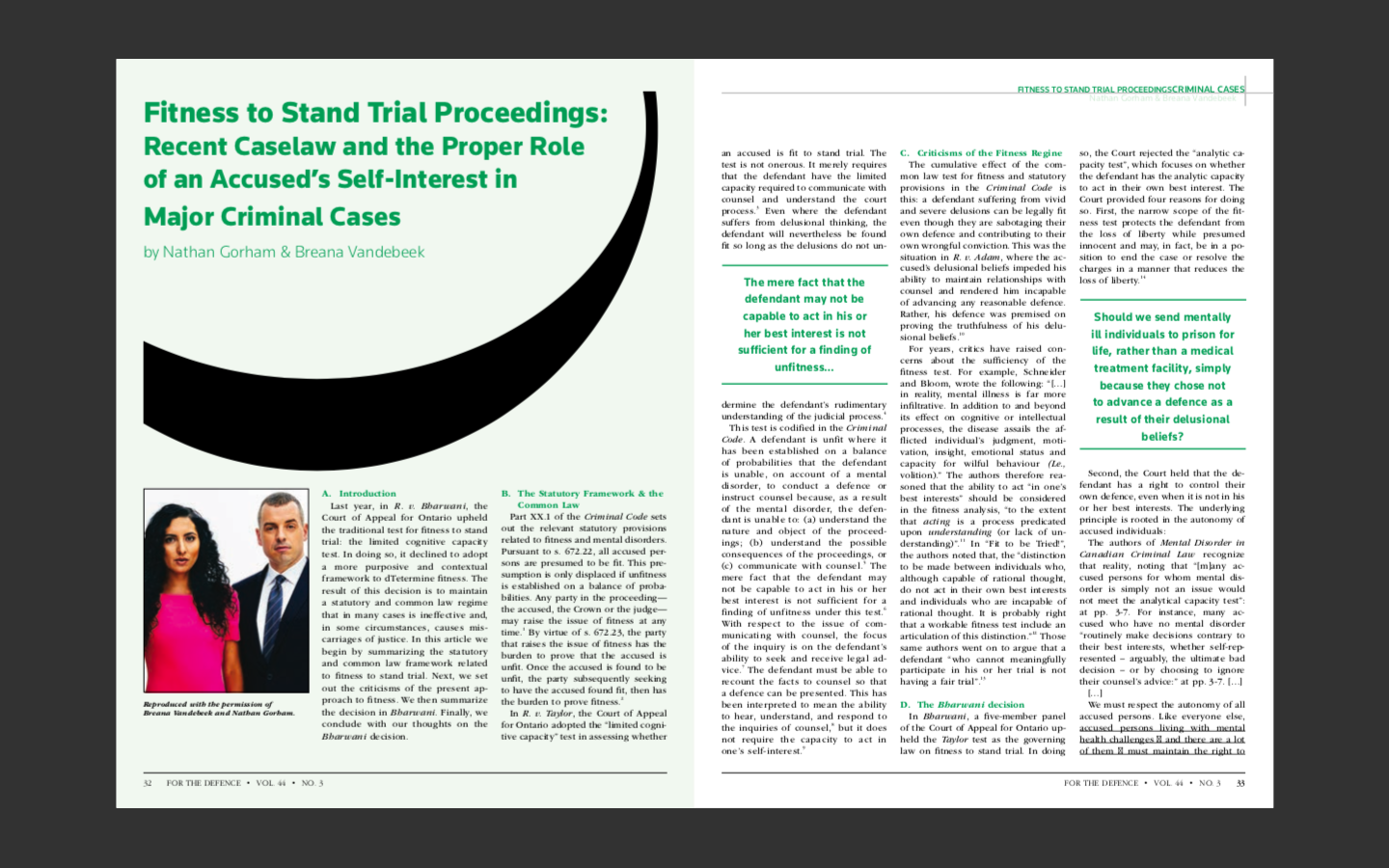
The arguments advanced here do rest on a presumption that life-long detention in a psychiatric hospital would have significant benefits over correctional incarceration, however. That’s a presumption that will be unpacked in the case our clients tackle next, called J.W. See you back here soon for my updates on that important case, scheduled to be heard on December 3, 2024.
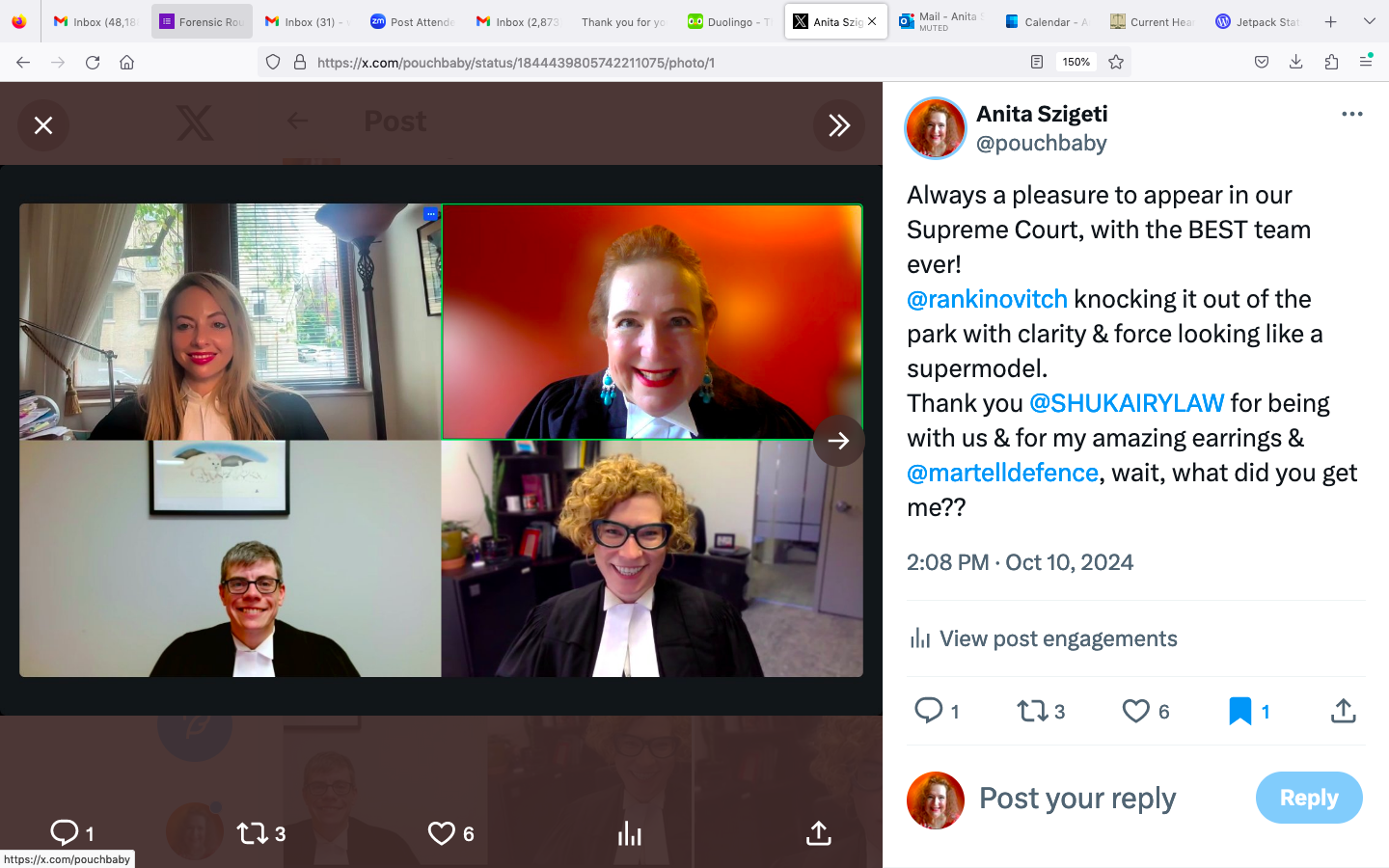
POSTSCRIPT – OCTOBER 10, 2024 – WE HAD A GREAT DAY IN COURT!
It was a real pleasure to watch Sarah Rankin make our submissions for EC – beautiful job she did.
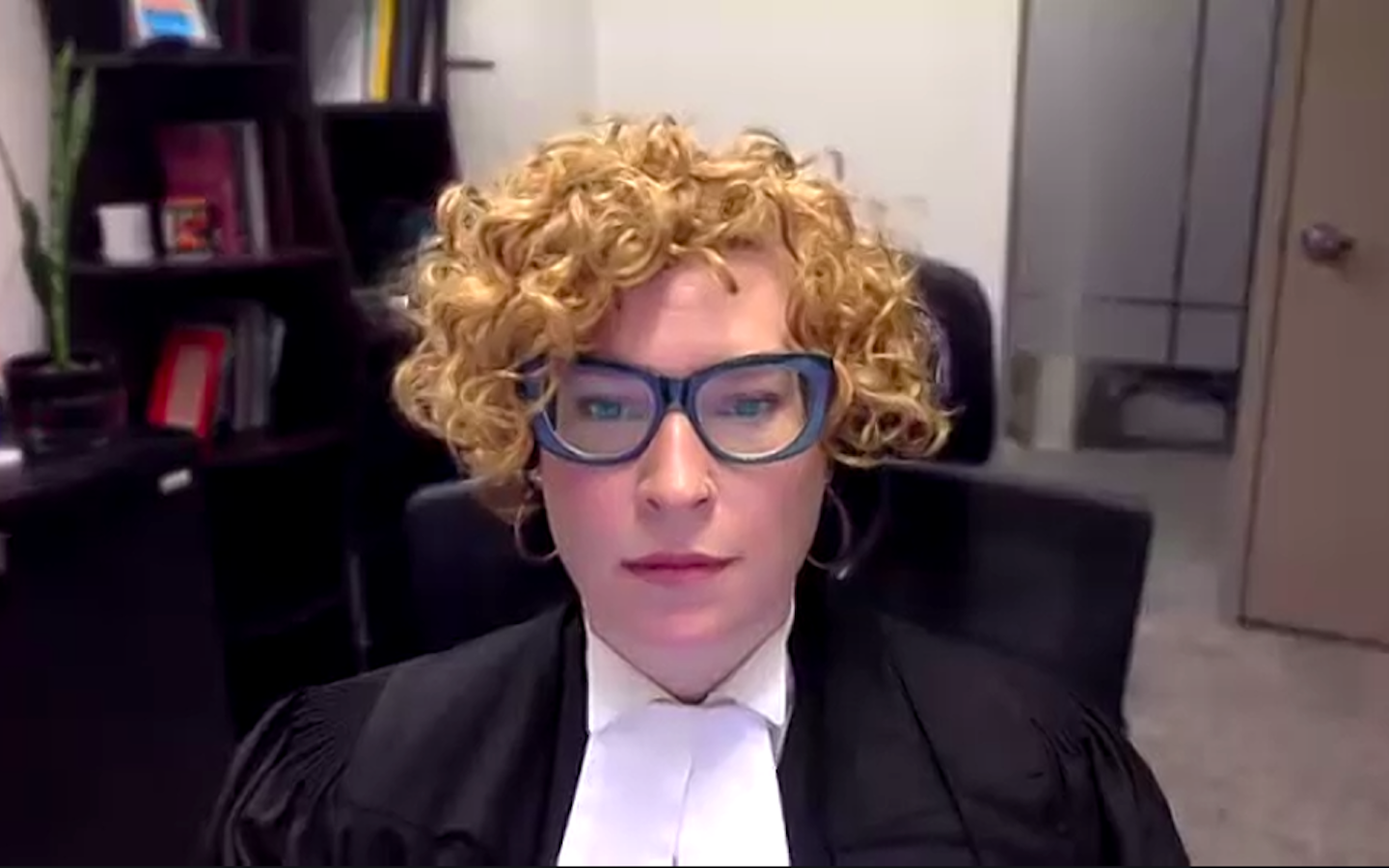
Also amazing advocacy by counsel for AG (Ont) including Dena Bonnet, one of the co-Editors on our new book – CAMHL, together with her co-counsel, Karen Papadopoulos.
We had a great team and a great day.

The archived webcast will be up shortly on the SCC website here – you can watch Sarah at the 1:15 mark or thereabouts after Erin Dann (WiCCD Woman 2023!) for the CLA – here:
https://www.scc-csc.ca/case-dossier/info/webcast-webdiffusion-eng.aspx?cas=40781


 anitaszigeti
Pingback: Great Day in the Supreme Court of Canada on Bharwani — October 10, 2024 | anitaszigeti
Pingback: Bharwani Judgment Released by SCC July 25 2025 | anitaszigeti