
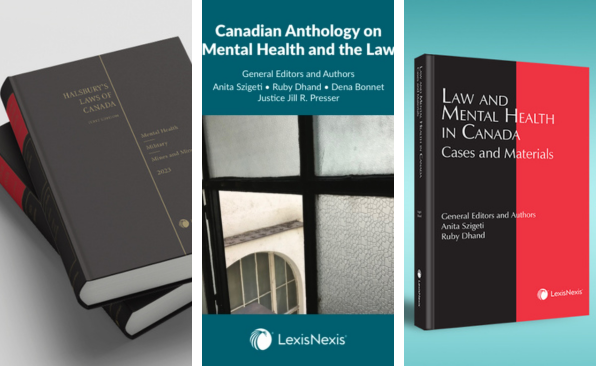
One of the most exciting aspects of my long career in the law has been my work in publishing text books on mental health law. As I celebrate 20 years in legal publishing, now including five distinct publications, I revisit the journey that got me here. I went back to look at documentation of the history of the works, and as it turns out, it’s not all quite as I had remembered it.
But what it boils down to, like everything else in my professional career, are personal relationships I so readily form, and for the long haul. In reflecting on these experiences, I am so grateful for the professional connections and ultimately genuine long-lasting friendships that are now so deeply intertwined with the publishing story aspect of my legal career. What a great ride!
For a more professional perspective on writing, editing and publishing legal texts, those interested may want to consult another blog entry here:
Personal Reflection on My Publishing Journey – This is How I Felt Traveling this Road
Here is how it all went down over the last two decades:
How It Started – 2003
I call this early spark the “Met a guy………” phase of my naissance as an author
Early in 2003, just after I argued my first case in the Supreme Court of Canada (as Amicus Curiae on Starson in January of that year), when my daughter was a brand new baby, the government fairly randomly assigned another lawyer onto an important file that, but for the vagaries of geography and the complication of a new-born, I would have been handling. I was asked if I wanted the file back, but I said, “let me talk to the guy first, and if he’s not useless, it’s probably fine to let him stay on the case.”
He turned out not to be useless. It’s a phone call I’ll never forget. Quite heady, head-turning stuff, a brilliant young mind and we had everything in common. It was like a lawyer love at first sight, or sound moment, where neither of us could get the words out fast enough and we were bonded by fate that day. The next six months were something else indeed. A vivid memory is one very long night in the art deco bar of an iconic hotel. I’m not sure a topic remained untouched that night. Over this period, we threw ourselves into working together on that one important file, but other significant cases as well. Through all this communication, by email and long phone calls, much laughter amidst the serious law, we somehow started to discuss writing a book together, half joking at first, and then in earnest. It may have been as much about having another big joint project to share as about the substance, in those early days, and yet we were not necessarily kidding around. There certainly was a book to write and a target market to serve.
From our emails in the fall of 2003 – when the seeds of the next 20 years and 5 books were planted:
I was thinking a textbook “Mental Health Law” might not be so difficult. Chapters could include fitness to stand trial, N.C.R., dispositions by CC Rev Bds, detention under mental health statutes, consent to treatnment, property management, CTO’s etc.
and then
Time to make decision re scope: all mental health law? criminal law/mental health law only? this is the first decision. Make the decision and get back to me.
The next batch of emails back and forth bandied about some potential co-authors or contributing authors, including some famed forensic psychiatrists, foreshadowing the birth of the Anthology some 20+ years later. Much of it was in jest, but again, at the heart of every joke lies some truth and that was certainly the case here. With all that said, there was never any question in his mind that his name would go first on that book. This too was a running theme in legal publishing, until I twigged to it in the later years and began setting that record straight.
At the end of the day, just reviewing those intense six months of multiple communications daily reveals an actual blueprint for my whole career in publishing for the coming two decades. All the ideas for all the books were canvassed between the two of us during that extraordinary period of brilliance and creativity born out of just a fondness between us that fueled our desire to work together on big things. That’s as I experienced it anyway, and that brief period of time has always meant a great deal to me.
How I was “Discovered” – 2004
This next phase may well also be summarized as “Met another guy…..” – a young man, actually, who would also go on to become a trusted professional contact for ages and a hilarious, brilliant, lovely guy whose successes in legal publishing since then are well-deserved and inevitable. A great, creative legal talent with exceptional inter-personal skills. Someone uniquely suited to managing complicated, difficult people and situations with a unique grace and effective de-escalating techniques!
In April of 2024, this product representative at LexisNexis at the time (back then Butterworths) reached out to me via email to say he had seen a presentation I gave at an OBA Conference the week before wrote this:
We are considering publishing an Ontario Consent and Capacity Legislation consolidation. A consolidation that provided thoughtful commentary on each included Act would be a far better and more marketable product. If we could publish before August, that would be even better.
Given your expertise in the area, I thought I would approach you about it. We are not talking about a massive undertaking in terms of page count. Anywhere from 30-75 pages of commentary would be fine. And you could get other members of your firm involved. If you are at all interested, why don’t you let me take you for lunch and we can discuss it.
My first book baby – is turning 20 this year!
So that was the beginning of it all for real. Those suggested 30-75 pages are now in excess of 700 or so, and we are celebrating the 20th Anniversary of this much beloved Guide to Consent and Capacity Law in Ontario. Looking back, I see I was asked whose name should go first. Out of deference for my then law partner, D’Arcy Hiltz, given his seniority and expertise in the area, I suggested he be named first author. He had been the Vice Chair of this tribunal even before I began practising in this area. It was the right call.
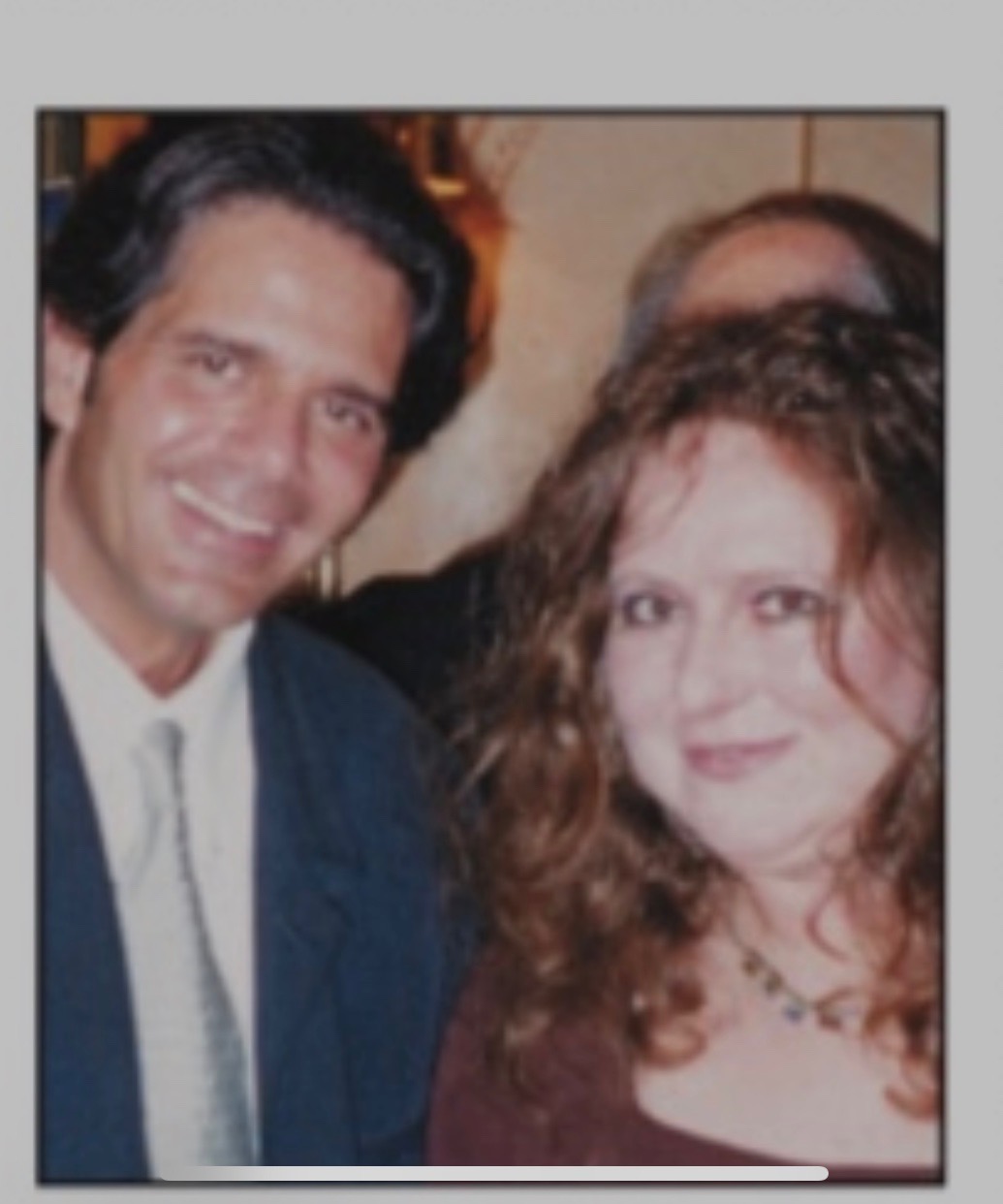
Now, we get to celebrate 20 years of tradition and excellence:

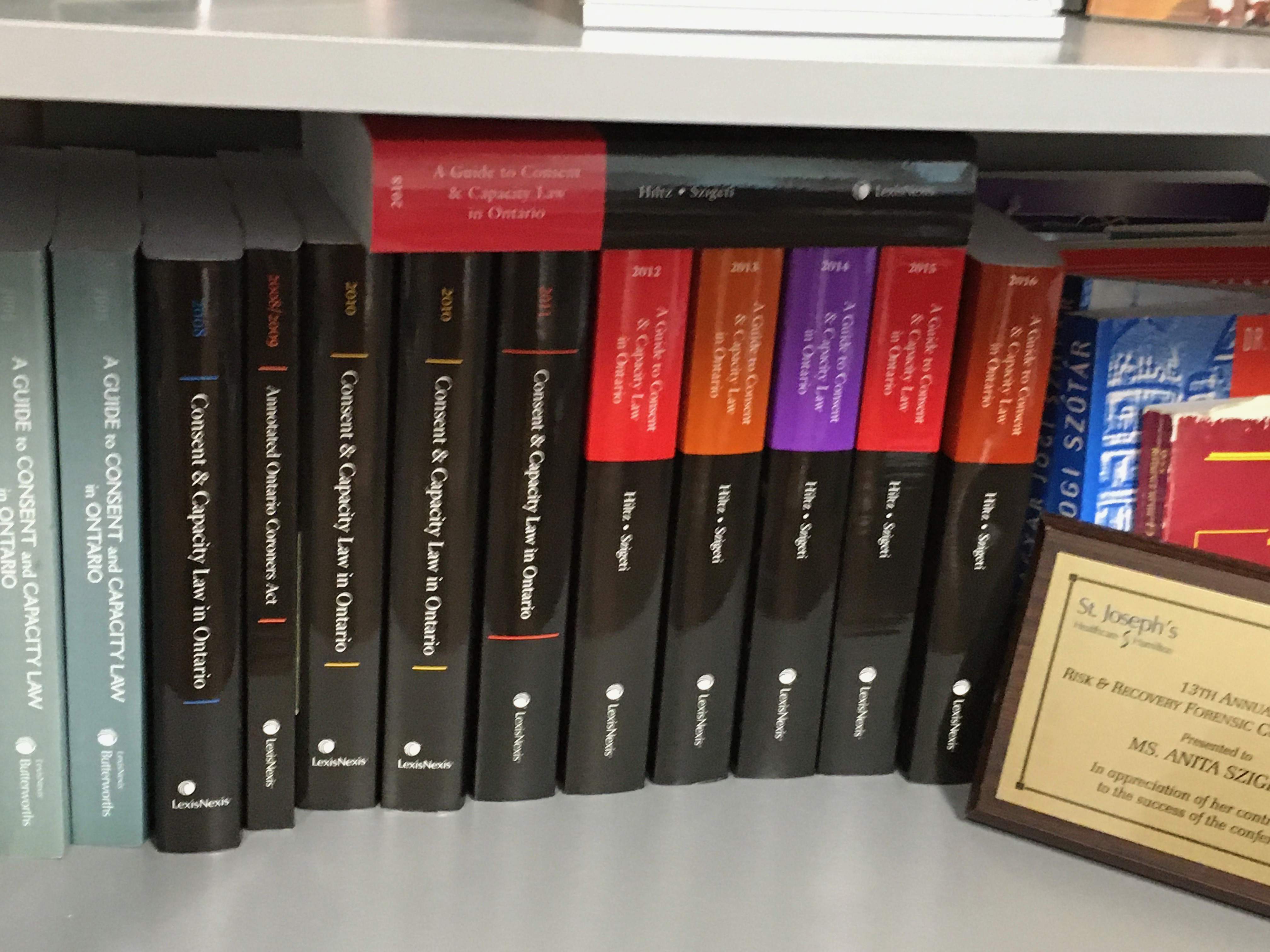
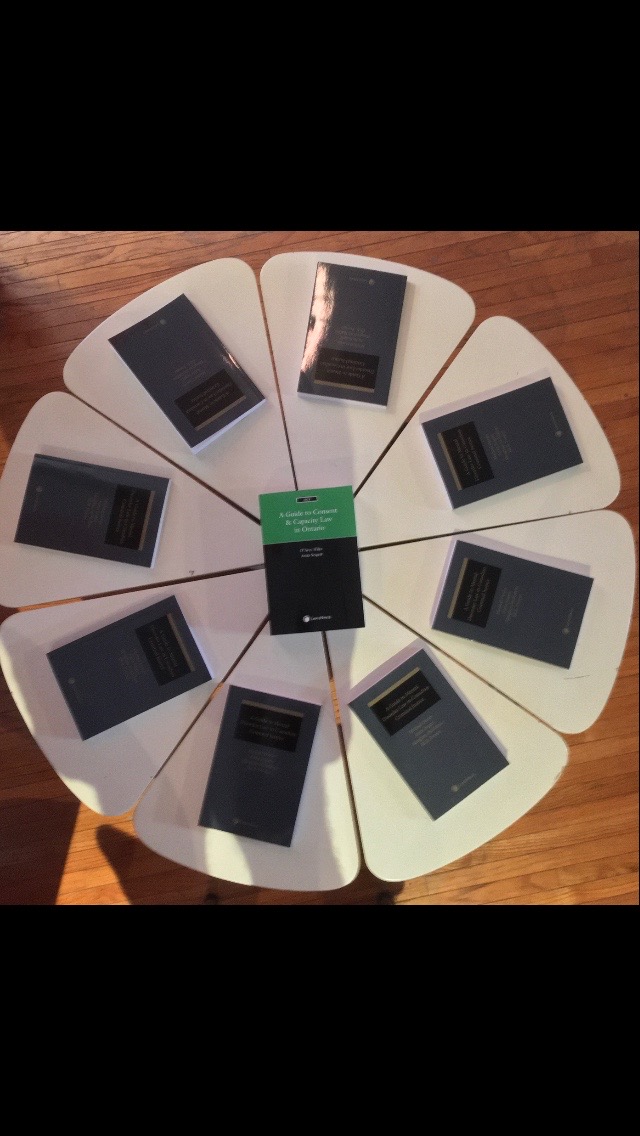
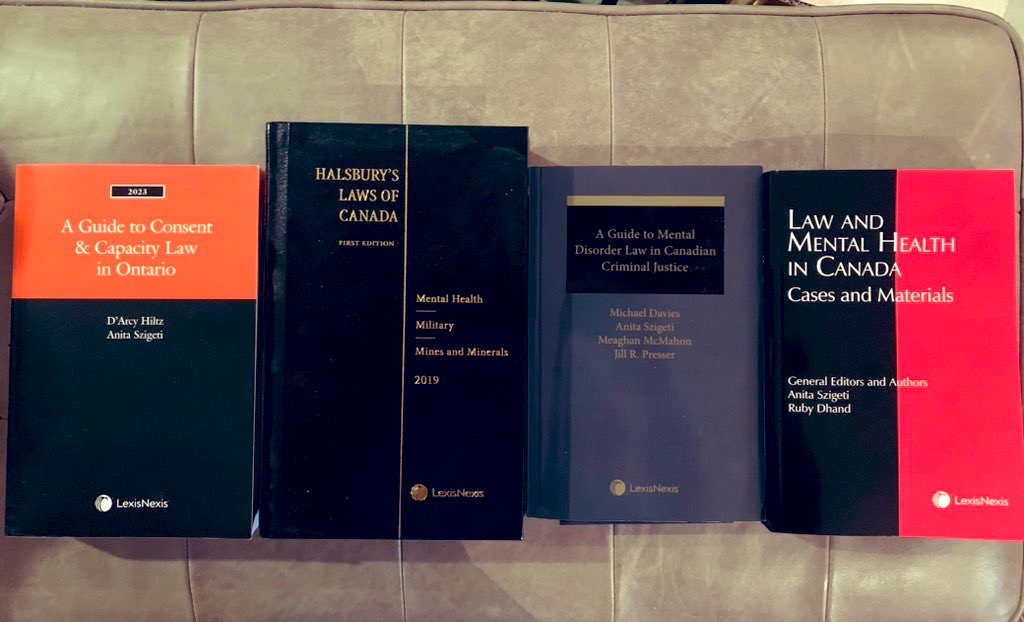
D’Arcy and I really had a wonderful time writing the first Edition of the CCB Guide. The pressure of less than five months to complete the book made us work particularly fast. It was an intellectually intense experience. In the process, we learned a lot, including new issues with the various pieces of legislation to be covered by the volume. We got a lot of litigation mileage out of what we unearthed. We also got to solidify for publication our combined expertise of many years in this specialized area of law. The annually updated Guide became a “Bible” for those who practise in civil mental health law before the CCB regularly and has continued for two decades to be the only such text. It is still wildly popular. Here is a big chunk of the published series over the years:
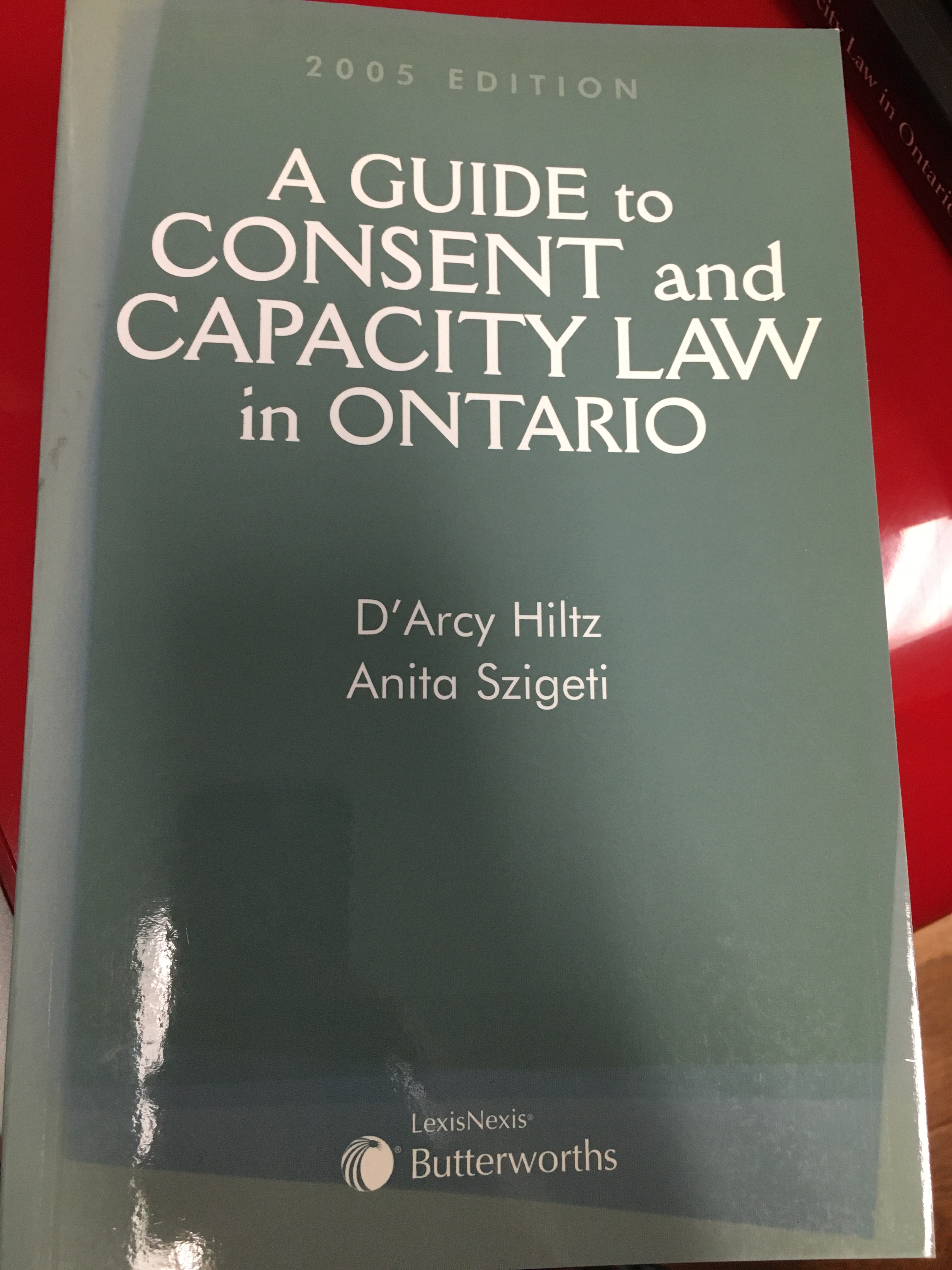
So in the fall of 2004, the first Edition – A Guide to Consent and Capacity Law in Ontario (2005) was born. It then all immediately fell apart. Literally. All the books had to be replaced because the publication was not as ordered (not “lay-flat” binding I learned) and with just scarce use, the pages would quite literally fall apart. So that was an inauspicious beginning. But at least I had meaningful input into the colour of the cover, which is, you’ll come to see, like nine tenths of what I care about. Funnily enough I had requested a dark grey or deep greyish blue, which was not available. Some 15 years later I’d get my wish. Of course by then I had not remembered my attachment to this particular colour scheme, but I guess I’m nothing if not consistent…..Here is the first Edition.
One Door Closes, Another One Opens Up – circa 2009
Another title for this section could well be “I lose one guy, gain two gals…..”
2009 or thereabouts was a tumultuous year. It probably had the most ups and downs of them all for me.
The Door That Closed – for a Decade
First, by then the textbook on criminal law and mental disorder whose kernel of an idea was formulated some six years earlier, was nearly completely written. I had assembled a group of four as a co-author team (this time two men, two women) and we had a contract to complete it by around 2009. Unfortunately, life intervened. There were work obligations, career changes and some interpersonal conflict that led to relationship break-down of a magnitude that made that project impossible to complete. In that sense, this was a very unhappy time.
Some people had withdrawn early for personal reasons, some weak attempts were made to replace some of the authors, but there were really two of us left standing, whose idea the work was and it was the two of us who had done all of the work to that point. I wasn’t even the main driver on this one, my colleague was. He had done the lion’s share up to that point, as I was facing significant personal issues at the time myself, was overwhelmed and to a degree paralyzed with fear. I wasn’t making a great deal of headway, though I desperately wanted to write and publish that book back then. My relationship to my one remaining co-author was hugely important to me. Alas, it was not to be, because we fell out, in a rather spectacular way. I was fairly gutted by all of that. So I put that project away and had no intention of ever revisiting it. I guess I didn’t count on the fact that the dream didn’t entirely die for everyone involved, but that’s a whole other chapter.
The New Door that Swung Open – Still Open Today
In the meantime, the product developer at LexisNexis whose idea the CCB Guide was to begin with had moved over to Halsbury’s of Canada within LN. He invited my law partner, D’Arcy Hiltz and I to contribute a Mental Health Law section to the famed Halsbury’s series. So in 2009 we started on that project, but this time I added a young woman to this author team.
In May of 2010 I met Ruby Dhand. By then I had become newly best friends with another woman criminal defence lawyer whom I met in the fall of 2008. Before I met each of these wonderful women, both had hounded me for a year or longer asking to grab lunch or meet. I ignored both for the duration, to my own great detriment. Those lost years were purely my loss.
In Ruby’s case she had been trying to interview me for her Master’s Thesis or her PhD’s empirical research regarding the Consent and Capacity Board. Eventually we met, she impressed me with her brilliance and kindness and we began working together. A lot.
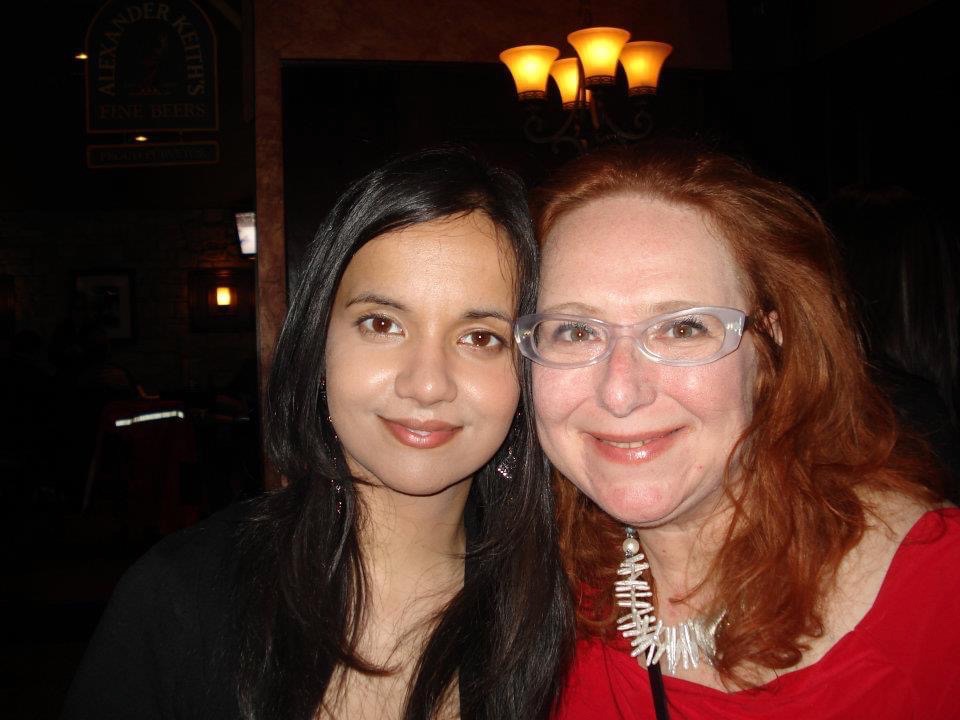
Among our first projects was the “wonderful Halsbury’s” as she still calls it to this day. With D’Arcy again at the helm, as first author, Ruby joined us. She has always, ever since, as she did then, lead us in the research for this particular publication, which spans all of Canada and covers the civil mental health legislation in all aspects. It is part of the Halsbury’s series, which is encyclopedic, and is therefore mainly found in law libraries. However, it is of enormous use to everyone who needs to consult statutory provisions about involuntary committal, guardianship or consent and capacity issues in any province or territory. This one took a longish while to get into print. We started it in 2009, added Ruby as co-author in 2010, and got it into print for the first time in 2011. Published every few years, the 2023 reissue is the fourth time we’ve published this volume and it is going strong!

An Old Door Reopens – 2019
In February of 2019, I experienced a surprise reconciliation that also came with a fairly shocking invitation to revive the mental disorder criminal law text project. I was really reluctant at first, for a host of reasons, but was eventually persuaded to agree to try to revisit this one. Maybe I should have listened to my gut, in hindsight. With that said, however, the actual year or so that followed, the process of creating this volume, was nothing short of magical.
The intellectual labour in producing this book is incredibly valuable. It is absolutely beautifully written, from cover to cover. Clear but effective, and in many ways, inspired. The other amazing thing about this book is it reads entirely as written with one voice. I know how and why that happened, but some things must remain private. This is one secret I will keep! In terms of my contributions to the substantive law, what I added to this book was a thousand times better than had I managed to complete it 10 years earlier. By 2019 I had transitioned my practice mostly to the criminal law of mental disorder and had immersed myself in it through the CLA and other community work, the entire time. I had a much greater impact now than I could have before. Due to the personal history of the book, I wanted this one to be perfect. I pushed myself to the limit and achieved a level of excellence even I hadn’t realized I was capable of. I recall this period as a kind of suspended in time joyous moment, a true labour of love.
There were real ups and downs to the story of this book, both in the short and long term. The first author on this book is another man. I know why I agreed to that — my impetus was purely emotional, and that’s one thing I do regret in retrospect. However, there was an element of a private joke to the order of author names that I still find amusing, so all was not entirely lost. The good thing was that I had insured we added two women this time to the author group. The number of women involved with each of my projects is by now steadily rising, a pattern that continues to this day. Another major accomplishment was the efficiency with which we worked together as a team. We produced the entire manuscript in about 10 months, from first Table of Contents filed in May of 2019 to final manuscript draft filed in March of 2020. The Book was in print by August of 2020.
We had completed our work just days before COVID-19 hit. We were therefore robbed of a real book launch party, which we were very excited about. The pandemic put a real damper on this project’s publication, as it did of course on every other aspect of all our lives. But even with all that said, the book was extremely well received, and to this day, four years later, I regularly hear from practitioners that it is an indispensable tool in their library, without which they’d never venture into Court on any mental disorder matter. Add to that, it is just as beautiful on the outside, as the inside, reflecting the genuine beauty of the process that brought it into the world.
A Revolving Door That Finally Stopped Turning
Ultimately, and upon much reflection, I do not regret producing this work. While I had perhaps naively imagined it may be another start of something particularly special, ultimately what it did was provide some closure on a fairly tortured period in my personal life. In the wake of its publication, with subsequent events that followed, it did have a life-changing impact on both my personal and professional interactions and outlook. So in many real ways, it was impactful at least. And as I say, people just love it!
Turning over a New Leaf – All Women All the Time – circa 2022
A great many things unfolded during the early years of the pandemic. The main thing for me was that I immersed myself in thinking about and working with my women colleagues in criminal defence, first leading them through COVID as The Women’s Director of the CLA and then forming Women in Canadian Criminal Defence (WiCCD). For at least several years, I was sort of done with men. I did commit never again to have a man’s name before mine on a project that I led. Book publications included. And to that I’ve certainly remained true, ever since.
Something for the New Kids on the Block
The next book marks a turning point for me in the way I now go about legal publishing. Ruby and I are the General Co-Editors and Co-Authors of this book, but we are no longer the sole co-authors. I decided to invite seven good friends to contribute or co-author chapters in a fairly conventional law school case book. None had ever been published in mental health law. I am named as first author for the first time. 8 of the 9 of us are women and our sole male contributor happens to be a trans man. This book wrote itself. There was no drama, no strife, everyone was easy, met tight deadlines and the book was really fun to write and edit. We had a good time together!
The more books I produce, the better I get at everything about the process. I have become a much better researcher, writer, editor, proof-reader etc. This book, in which I co-authored fully 10 of its 19 chapters, was completed in record time. The first Table of Contents we used to pitch the idea is dated April 25, 2022 and the Manuscript was filed with our publisher on July 22, 2022. It was released on December 31, 2022 but really available in print to ship on Jan 2, 2023. Still, it was created in less than three months!!
This book is a wonder. What it does is it allows anyone tasked with or wanting to teach a mental health law course at any Canadian law school to do so, without doing another thing. This is happening in fact across the country. Several new courses have sprung up, created entirely as a syllabus based on the contents of this book. Our contributing authors have also made great use of the product this way. One has since established her own course at a leading law school based on this book, and Ruby and I use it a as a basis for our Mental Health Law Course within Osgoode PD’s Health Law LLM. Many other courses across Canada use it as the required student text.
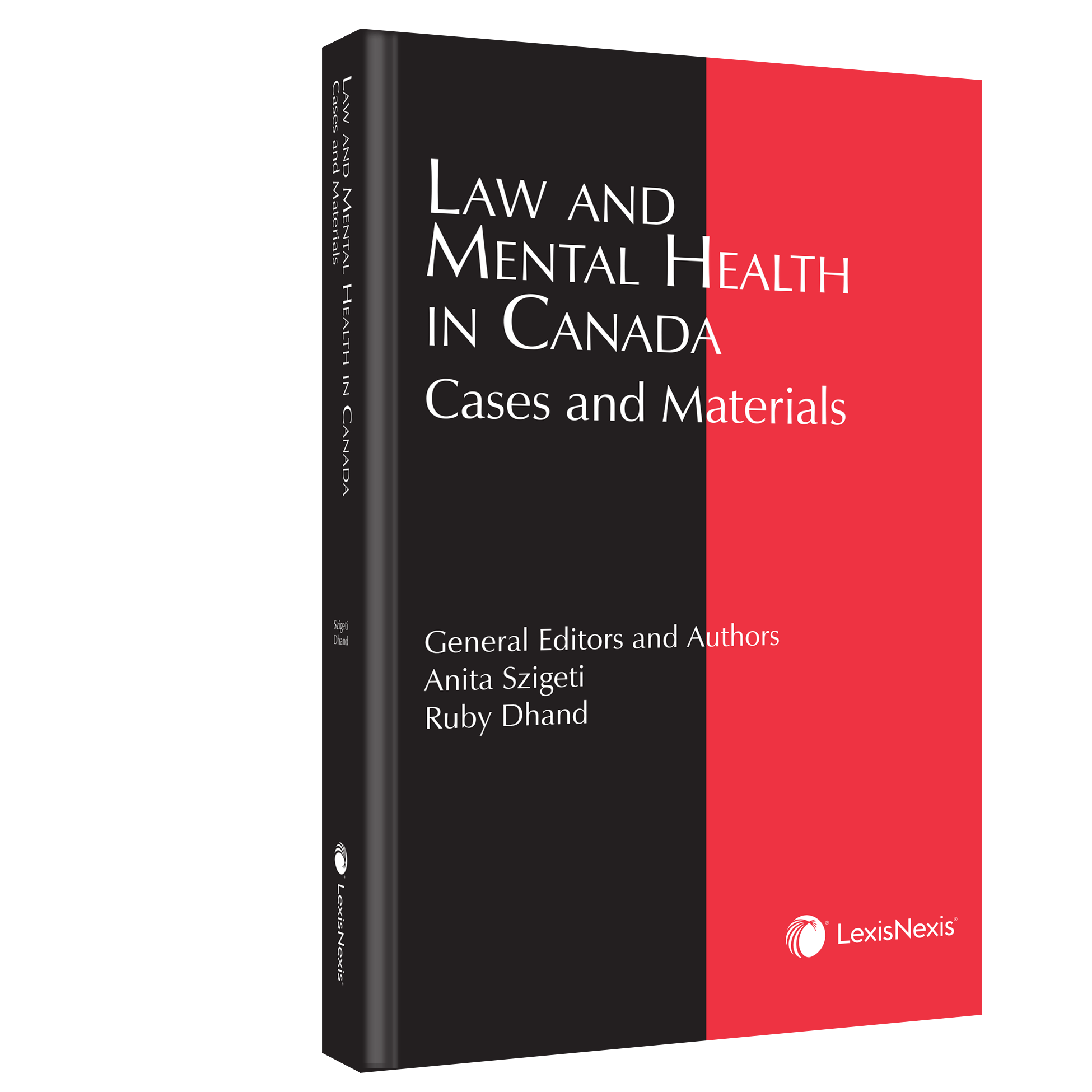
For more on the relationships I have with Ruby and our contributors, see these blog entries about the Law and Mental Health in Canada: Cases and Materials casebook.
The Final Frontier – A Massive Multidisciplinary Undertaking – 2024
The Canadian Anthology on Mental Health and the Law is a huge departure for me. Four women General Editors, a Judge, a Crown attorney and of course Ruby representing academia, then me for the defence. 70 contributing authors from all walks of life where mental health and the law intersect. I’ve blogged extensively about this project and I won’t repeat it here. The miracle of this volume is that it took exactly as long to complete as a baby takes to gestate. 9-10 months. From June of 2023 to March of 2024. This was no easy feat. It was an intense and challenging project. Ultimately more than a thousand pages of text. Academic and lived experiences. Mental health lawyers and service providers. Families, victims and clients. Civil and forensic psychiatric legal issues. Indigenous and Black critical theories and perspectives. An absolutely breath-taking array of content. For me personally, the most gratifying to see come to fruition. How it will be received is yet to be seen as it won’t be in print for another two months, due in print on September 10, 2024 now.

One of the things I’m super excited about is getting my first photo credit for the image on the front cover. I took that picture on a family trip to Budapest, Hungary in the summer of 2018 and it comes with a backstory – I feel it is the perfect shot for this volume. My negotiations with the Editing team to allow me to do this honestly provided some of the most hilarious levity in the publishing process. I am grateful for all of it.
On a more serious note, I am eternally grateful for the lovely Forewords in this one. Among them, incredibly thoughtful and meaningful endorsements for this text from Ontario’s Associate Chief Justice, The Honourable J. Michal Fairburn, who was a classmate of mine at law school, and The Honourable Robert P. Armstrong, K.C., someone I’ve known since I was a law student, who was an early career mentor. I am personally moved and we are all truly honoured to have both these hugely accomplished leaders of our profession comment favourably on this work. Justice Sanjeev Anand of Saskatoon, Saskatchewan, whom I did not know at all prior to this project, is a universally respected Jurist long admired by Ruby, whose Foreword is also comprehensive and humbling. We are so blessed!
I am co-author of seven of the 50 chapters in this book. Many are long, complex contributions that required a great deal of original research. Some of the topics covered in my chapters had never been explored before by anyone, anywhere. This aspect of it I found particularly rewarding, if challenging. I learned a lot. I had a much more significant role in editing this manuscript than I had played before, and the size of the project meant organizational structures to keep us on track had to be put into place. I was in charge of managing all that and in the process, learned a lot there too. I also got more experience in dealing directly with a lot of extremely smart people on a ton of substantively fascinating legal topics and made many new friends and professional contacts.
I also had the unique privilege of co-authoring chapters together with role models, people I have respected and admired professionally for a long time, included Judges, law professors and forensic psychiatrists. I also had the opportunity to co-author two really interesting chapters with cherished defence colleagues and good friends and one with our co-Editor from the crown side of the equation. In the process of making sure His Honour had what he needed to write our Foreword, I got to enjoy a lovely correspondence with Bob Armstrong, which made this already special project, even more joyous. So another side-benefit, even though 2/3 of our authors are women, was that I learned to work with men again and while this may seem odd, I am glad to know I’ve not gone completely off them despite some earlier bad experiences over the last number of years. Feels strangely, but happily, healing!
I’ve blogged quite a bit about this book, starting here:
And here is where you can find it if you’re interested in purchasing a copy or want more details!


 anitaszigeti