
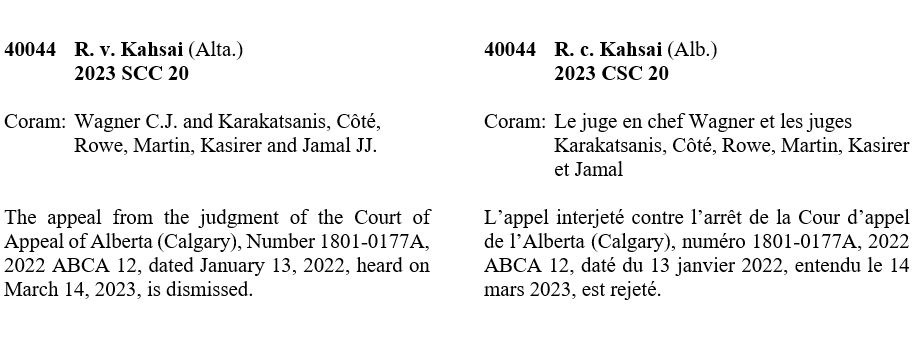
Despite that the appeal was lost, the Judgment is a very helpful clarification of (dreaded) CLA v AG, which has been a bit of a thorn in my side anyway for 10+ years now.
Really excellent language in this Judgment that should provide trial judges guidance and affirms the broad discretionary powers they have to appoint amicus curiae including with defence-like duties in appropriate, if “unusual” cases.
This case will have significant (positive) ramifications for the particular subset of accused persons our client the Empowerment Council was concerned with, those charged with criminal offences who are experiencing serious mental health issues even though they have been found fit to stand trial and choose to represent themselves or otherwise find themselves unrepresented.
It is also gratifying to have a submission EC made specifically cited by the Court. Here is a link to the Judgment:
https://decisions.scc-csc.ca/scc-csc/scc-csc/en/item/20016/index.do
The Plain Language Summary:
https://www.scc-csc.ca/case-dossier/cb/2023/40044-eng.aspx#criminallaw
The link to my earlier blog entry about our appearance for the EC in Court:
Some of the meatiest parts of the Kahsai Judgment here:
[57] The responsibilities of the trial judge and the Crown can go a long way to ensure trial fairness and, in the vast majority of cases, will suffice to prevent a miscarriage of justice. Yet there are limits tied to the roles of judge and Crown counsel in an adversarial proceeding, and their assistance will not always be enough to ensure a fair trial. Appointing amicus with adversarial functions may be required to restore some balance in “unusual cases”, including when an unrepresented accused displays symptoms of mental health challenges, but is nevertheless fit to stand trial, or where the unrepresented accused refuses to participate in the trial (see C.M.L., at para. 68). It may also be required where the nature of the charges or the mode of trial make an adversarial perspective from amicus necessary for the case to be justly adjudicated (see Walker, at para. 64; R. v. Brooks, 2021 ONSC 7418, at para. 44 (QL, WL); C.M.L., at paras. 76 and 86).
[58] Generally, the court must respect the strategic choices of an accused person who is fit to stand trial, even where those choices seem irrational or unwise (see Bharwani, at para. 157). Still, courts have recognized that in “complex cases involving self-represented accused with mental, behavioural, and/or cognitive challenges”, the risk that the adversarial process will be compromised is particularly acute (Walker, at para. 63). And as the intervener the Empowerment Council notes, the low threshold for fitness means that defendants may be fit to stand trial despite experiencing serious mental, behavioural, or cognitive challenges (see I.F., at para. 18). In that event, it may be challenging to ensure a fair trial, and assistance from the trial judge and the Crown may not suffice. Amicus can be a flexible tool to mitigate these risks and help trial judges maintain the integrity of their trial process when these types of unusual circumstances arise (R. v. Imona-Russel, 2019 ONCA 252, 145 O.R. (3d) 197, at para. 72; Jaser, at para. 35; Walker,at para. 71).
(2) Considerations in Determining the Scope of the Role of Amicus
[59] Subject to the limitations we have identified above, the trial judge is best positioned to determine what type of help is required and has wide discretion to tailor the appointment to the exigencies of a case (see R. v. Samra (1998),41 O.R. (3d) 434(C.A.); Imona-Russel, at para. 92). Exceptionally, appointing amicus with an adversarial mandate may be necessary for the court to fulfill its responsibility to maintain a fair and effective trial — particularly when imbalance in the adversarial process threatens to create a miscarriage of justice.
[60] Many recent cases illustrate where courts found it necessary to appoint an amicuswith adversarial functions. For example, courts appointed an amicus with a defence-like role where the accused was unwilling to retain a lawyer and did not actively participate in the proceeding (R. v. Borutski, 2017 ONSC 7748; R. v. Chemama, 2016 ONCA 579, 351 O.A.C. 381; C.M.L.); where the accused represented themselves, but could not advance a competent defence (Walker; Jaser, at para. 35; R. v. Ryan,2012 NLCA 9, 318 Nfld. & P.E.I.R. 15); where the accused was disruptive, abusive of court process, or determined to derail the proceedings (Brooks; R. v. Mastronardi, 2015 BCCA 338, 375 B.C.A.C. 134, at paras. 9-10 and 50; C.M.L.); and where complex issues or serious criminal charges made an adversarial perspective necessary for trial balance and fairness (Mastronardi; Imona-Russel, at paras. 30-31; Brooks, at paras. 43-44; Borutski; Jaser). In many of these cases, the court appointed an amicus with an adversarial role only after explicitly determining that the dangers identified in CLAO would not materialize (Borutski, at para. 29 (CanLII); C.M.L., at para. 71; Mastronardi, at paras. 44-47; Imona-Russel, at para. 93).
[61] As these cases reveal, the trial judge should consider the circumstances of the trial as a whole when determining whether to appoint amicus with an adversarial role. This includes the nature and complexity of the charges (see Ryan, at para. 156; Walker, at para. 64; Brooks, at para. 44); whether it is a jury trial or judge alone (see C.M.L., at paras. 76 and 86; Brooks, at para. 44); the attributes of the accused, including where they are unrepresented and any concerns about mental health challenges or their ability to cooperate with the court (see Walker, at para. 64; Mastronardi, at paras. 50‑52; Brooks,at para. 44; C.M.L.); whether assistance is needed to test the Crown’s case or advance a meaningful defence (see Borutski, at paras. 23, 28 and 31; Ryan,at para. 156); and what assistance the Crown and trial judge can provide within their roles (see C.M.L.,at para. 80; Imona-Russel,at para. 69; Ryan,at para. 156).
[62] Amicus can legitimately assume a wide range of adversarial functions throughout the proceedings, within the scope of the limits identified above. For example, I accept the submission of the intervener the Criminal Lawyers’ Association that amicus can help the accused by explaining the strategic choices available to them, along with the potential implications of those decisions (see I.F., at p. 2). And there is no theoretical barrier to prevent amicus from testing the strength of the Crown’s case through cross-examination, submissions or closing argument (see Mastronardi; Borutski; C.M.L.; Walker). As noted above, amicus may present an alternative theory or defence arising on the evidence to counter the position of the Crown, provided it does not conflict with any asserted theory or defence of the accused. Other adversarial functions may also be available.
[63] That is not to say a broad adversarial mandate for amicus is always necessary, nor that it should be close to routine. The dangers established in CLAO led this Court to affirm that the power to appoint amicus must be reserved for exceptional circumstances. But these dangers do not stand in the way of maintaining public confidence in trial fairness — and as several authorities illustrate, they can be accommodated with an appointment order carefully tailored to the circumstances of a particular case.
D. Summary and Best Practices
[64] In sum, in the vast majority of cases, the responsibilities of the trial judge and the Crown will suffice to ensure trial fairness. Once it is determined that amicus is required, the trial judge retains wide discretion to appoint amicus with functions that are responsive to the needs of a case. This may include adversarial functions where necessary for trial fairness — for example, to restore balance to a proceeding when an accused chooses to self-represent and puts forward no meaningful defence. In tailoring the scope of the role for the amicus, the judge will consider the nature of the role of amicus as friend of the court and the circumstances of a case, including how the accused exercises their constitutional rights and what is needed to ensure a fair trial. While there are necessary limits to the adversarial functions that amicus can perform, the scope is broad enough to accommodate what is necessary for trial fairness in a particular case.
[65] In considering whether to appoint amicus, the judge should canvass the parties for their perspectives about the necessity and scope of an amicus appointment. The judge should consider whether an appointment that is limited in duration or scope would suffice. For example, assistance from amicus may only be necessary for cross‑examination of certain Crown witnesses or for a particular motion in the proceeding. It would also be helpful to reduce the terms of appointment to writing in a formal order or endorsement, explicitly identifying the nature and scope of the role for the amicus and the specific functions that the court requires.
[66] Finally, the trial judge should consider whether the mandate assigned to an amicus will make a confidentiality order necessary for the amicus to effectively discharge their role. As the intervener the Criminal Trial Lawyers’ Association submitted, full and frank conversation between the accused and an amicus may depend on a confidentiality order if the amicus is charged with advocating for the interests of the defence (see I.F., at p. 7).While solicitor-client privilege would not be available, a confidentiality order would create legal protections for communications between the amicus and the accused in discussing their case (see, e.g., Imona-Russel, at paras. 64 and 68, explaining how an undertaking by Crown counsel to treat all correspondence between the accused and amicus as privileged achieved the confidentiality necessary in that case).
MEDIA
Here is a link to Sean Fine’s Article in the Globe and Mail on July 28 2023
Some quotes attributed to intervener counsel on the case:
The ruling’s broader importance lies in its guidance to judges seeking to protect trial fairness. Superior court judges have always had the authority to protect the integrity of the legal process in their courtrooms. But traditionally, an amicus played a more neutral role, says criminal-defence lawyer Anil Kapoor. If, for instance, a judge asked whether certain evidence should be excluded from the trial, the amicus would give both sides, without advocating a position.
“A more partisan person would take the position of the accused, who is unable to advance a legal argument for lack of skill, and indicate a result that would favour the accused person,” said Mr. Kapoor, who represented an intervenor, the Criminal Lawyers’ Association, in the Kahsai case.
Mr. Kapoor said courts cannot “force” a lawyer on an individual, and that remains true. But the ruling gives judges the tool “to appoint amicus to be more partisan if the circumstances call for it,” he said, “all with a view to ensuring that the trial process is a fair process.”
Justice Andromache Karakatsanis, writing for the unanimous court, said it is up to the judges who appoint such representatives to decide how far they may go – though they cannot act fully as defence lawyers, partly because it would conflict with the right of the accused person to represent themselves.
“The trial judge is best positioned to determine what type of help is required and has wide discretion to tailor the appointment to the exigencies of a case,” Justice Karakatsanis wrote.
In some cases, judges may even be obliged to give amicus broad permission to be partisan in opposing the Crown, the court ruled.
“Exceptionally,” Justice Karakatsanis wrote, “appointing amicus with an adversarial mandate may be necessary for the court to fulfill its responsibility to maintain a fair and effective trial – particularly when imbalance in the adversarial process threatens to create a miscarriage of justice.”
Anita Szigeti, a lawyer representing the Empowerment Council, which advocates on behalf of people with addictions and other mental-health issues, said self-represented accused should probably be called the “unrepresented.”
“Many people are not able to self-represent effectively.”
She said the ruling sets out a potentially broad scope for amici: “This is a very important judgment. It will hopefully put a stop to trial courts occasionally refusing to appoint amicus curiae with a sufficiently partisan mandate to really level the playing field.”


 anitaszigeti
Pingback: Who Cares About Amicus?? A WiCCD Special Episode unpacking the SCC’s Judgment in R v. Kahsai – Aug 13 2023 | anitaszigeti
Pingback: Anita’s 2023 Year-End Recap – The Good News Story is All about Publishing and Teaching this Year | anitaszigeti