On July 13, 2022 the Ontario Court of Appeal Released this Judgment, granting Matthew Gibson an absolute discharge from the Ontario Review Board’s jurisdiction.
The case is available here:
And here:
https://www.ontariocourts.ca/decisions/2022/2022ONCA0527.htm
Lawyer’s Daily has covered the case available online here:
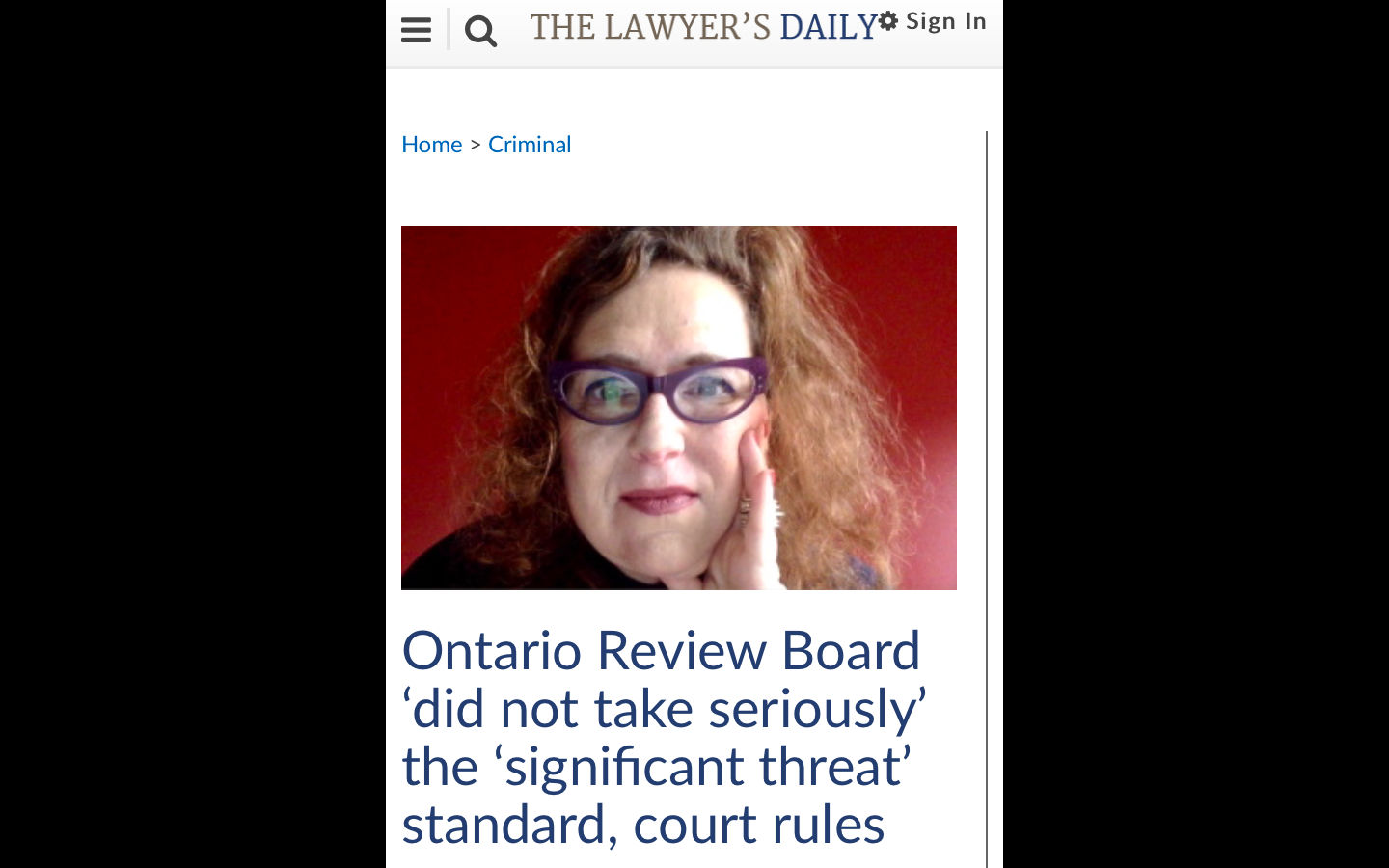
7/18/22, 9:39 AM Ontario Review Board ‘did not take seriously’ the ‘significant threat’ standard, court rules – The Lawyer’s Daily
The Lawyer’s Daily | 111 Gordon Baker Road, Suite 900 | Toronto, ON M2H 3R1 | http://www.thelawyersdaily.ca
Criminal
Ontario Review Board ‘did not take seriously’ the ‘significant threat’ standard, court rules
By Amanda Jerome
(July 18, 2022, 9:25 AM EDT) — The Ontario Court of Appeal has issued an absolute discharge for a not criminally responsible (NCR) accused who had been under the purview of the Ontario Review Board for over 15 years, determining that the “evidence does not meet the ‘onerous’ standard under s. 672.54 of the Criminal Code.”
In Gibson (Re) 2022 ONCA 527, the appellant, Matthew Gibson, appealed an Ontario Review Board decision made in 2021 “ordering that he remain subject to a conditional discharge.” Gibson argued that “the Board erred in finding that he remains a significant threat to public safety” and sought an absolute discharge.
According to court documents, Gibson is “52 years old and has been under the Board’s jurisdiction since January 31, 2006, when he was found not criminally responsible of breach of recognizance and criminal harassment.”
Gibson, the court explained, was “involved in a serious motorcycle incident in 1984, which left him in a three-and-a-half-week coma.” His mental health issues “escalated” and his current “diagnoses are Schizophrenia, Undifferentiated Type, Closed Head Injury, Minor Sequelae, and Cannabis Use Disorder.”
The court noted that in 2005, Gibson “entered into a probation order for assault with a weapon and criminal harassment.”
According to court documents, Gibson had “taped a note to a neighbour’s vehicle addressed to the owner’s daughter for the second time in a two-month period. The neighbour confronted the appellant, who then pointed an eleven-inch steak knife at the neighbour and stated, ‘don’t fuck with me.’ The neighbour called the police.”
A couple of weeks later, while subject to a probation order, Gibson “attended at another neighbour’s residence and asked the resident to deliver a plastic bag containing clippings of photographs of the former homeowner’s family to that homeowner.”
The resident delivered the package the following day and then the “appellant repeated the request with a second package.”
“This time the former homeowner called the police and provided a video to them, showing the appellant on the lawn yelling at the family. He was arrested and charged with failing to comply with his probation order,” the court explained.
With regards to the board’s reasons, the court noted that Gibson’s “insight into his mental illness and need for medication remains limited. He does not believe he has schizophrenia, though he has remained adherent to his medications.”
The hospital report, the court added, “includes a psychological risk assessment, which concludes that the appellant’s risk for future violence is moderate while under the Board’s jurisdiction and would be high otherwise.”
The report also noted that “although the appellant’s present disposition requires that he be seen at least twice per month, he has had five weekly contacts with his professional supports while residing in the community.”
The Board explained that Gibson “required readmission into the hospital three times in the past year, his housing was unstable, and his threat to public safety is moderate-to-high absent the oversight of the forensic system.”
“On this basis he was to continue to be discharged on conditions, with the amendments suggested by the hospital,” the court added, noting that the Board “accepted the hospital report’s conclusions and based its disposition on them.”
“The Board concluded that, on the evidence, the appellant continues to represent a significant threat to the safety of the public …” the court explained, emphasizing that the Board “added an important amendment to a condition in the previous disposition: that the appellant ‘abstain absolutely from the non-medical use of alcohol or drugs or any other intoxicant, save and except cannabis obtained through a medical prescription …’ ” (With the underlined words being newly added.)
Justice Peter Lauwers, writing for the Court of Appeal, noted that the “Board’s approach did not take seriously that the ‘significant threat’ standard is an onerous one.”
“The Board downplayed the evidence that showed the appellant’s ability to cope with his disease, instead relying on some rote themes that this court has questioned and rejected on several occasions,” he stressed, adding that there are “several pieces of cogent evidence that the Board failed to take into account.”
The first piece, Justice Lauwers noted, was that “apart from the now very dated index offences, there is no record that the appellant has made threats or been violent, even during times when he was in psychosis.”
“There is simply no evidence to suggest that his discharge poses a real risk of serious criminality. That conclusion is no more than speculative on the evidence,” he wrote, going on to emphasize six additional factors.
“Second, the appellant has lived successfully in the community for years and without incident. Third, he has complied with his medication requirements. Fourth, he voluntarily seeks assistance when he is decompensating, despite his limited insight. Fifth, the transient instability in his housing situation was explained and has been resolved. Sixth, the appellant has formed a durable relationship with a non- forensic treatment team and complies with their advice. This team will serve in place of the forensic team. Seventh, as the additional and new condition appears to recognize, the appellant has demonstrated his ability to consume medical cannabis as needed for medicinal reasons, and this has lessened his use of street cannabis with high-THC content that can provoke psychosis. When symptoms have appeared, the appellant has voluntarily sought assistance and done nothing anti- social,” he explained.
Justice Lauwers noted that the Board “invokes the appellant’s limited insight as one justification for continuing his conditional disposition.” However, he explained, this court has “repeatedly said that this is not, in itself, sufficient to establish a significant threat to public safety.”
“Despite his limited insight, the appellant has advised his treatment team and the Board that he will continue to take his medications after discharge. He testified that he is ‘schizophrenic’ and ‘sick.’ The appellant self-administers his oral antipsychotic medications and is fully compliant, as confirmed by screenings. He has reminded the treatment team to renew his prescription when his supply is low. This shows that his limited insight is adequate,” the judge added.
The court acknowledged that there is “no doubt that the appellant has ongoing mental health issues.” “While these are relevant, they are not necessarily determinative of risk,” the court added.
Justice Lauwers, with Justices Lois Roberts and Gary Trotter in agreement, determined to allow the appeal and ordered an absolute discharge in a decision released July 13.
Anita Szigeti, counsel for the appellant with Maya Kotob, said “it was a very happy call” she made to her client to “let him know that after 16 years of detention and supervision, as an NCR accused, he was now, finally, free.”
Anita Szigeti, counsel
“Mr. Gibson has been seeking his absolute discharge from the Ontario Review Board for eight years, and through eight consecutive appeals to the Court of Appeal. Through his own tenacity and perseverance, he has finally succeeded,” she added.
Szigeti, who is president of the Law and Mental Disorder Association (LAMDA), said the judgment “does not necessarily add anything entirely new to the law. However, it does a number of other very important things.”
“First, it reinforces earlier judgments from the court and extends a developing line of cases that go back to around 2017, starting with a case called Wall (Re), 2017 ONCA 713, which amount to very clear guidance from the court to this review board that they must keep their eye on the ball,” she explained, not that “the Review Board’s sole role is to determine whether an NCR accused continues to pose a significant risk to the safety of the public” and that “the test for ‘significant risk’ is ‘onerous.’ ”
“All of which is to say that a whole host of other things that might be true, and might be concerning, nonetheless do not justify keeping an individual under the criminal law’s jurisdiction, whether for ‘their own good,’ or because we think there’s still room for further improvement in their mental health condition. This case is illustrative of these foundational principles,” she added.
Szigeti stressed that this “case makes it very clear that the NCR accused does not have to be perfect to be discharged absolutely.”
“Not all their risk factors have to be completely addressed or eradicated. There is always room for improvement, more supports can always be found later, a person can be stable for longer, but they’re not required to pose zero risk in order to be entitled to a discharge. Where they are not likely to commit a serious criminal act when discharged, they must be discharged. The Review Board cannot hang its hat on looking for another year of progress to use as a proxy for significant risk,” she explained.
“Second,” she continued, “the court is also building on its line of cases going back to Sim (Re) 2019 ONCA 719 and reaffirmed in Sim (Re) 2020 ONCA 563 that the Review Board cannot just defer to the psychiatric evidence without equal and fair treatment of the evidence in favour of the accused, including the accused’s own evidence.”
“The Board cannot ignore evidence that does not support their finding of “significant risk” when the accused has a proven track record of doing well despite using substances or still having overt symptoms. If the individual has managed to cope with such challenges without posing a risk to the public’s safety, that is evidence that must be taken into account seriously,” Szigeti noted.
“Third,” she added, “the court in this case signals some palpable frustration with the Board’s continuing struggles, in some cases, to appreciate what they must do to evaluate and address this threshold issue of ‘significant risk’ fully and fairly.”
“The court had the option of returning this matter for rehearing with directions, but they chose to substitute an absolute discharge directly. That in itself, in my view, sends a strong message,” she said.
Szigeti also drew attention to the “pointed language and strong direction to the Board” in paragraph 19, where the court states the Board’s “approach did not take seriously that the ‘significant threat’ standard is an onerous one.”
The Ministry of the Attorney General did not provide comment before press time.
If you have any information, story ideas or news tips for The Lawyer’s Daily please contact Amanda
Jerome at Amanda.Jerome@lexisnexis.ca or call 416-524-2152. © 2022, The Lawyer’s Daily. All rights reserved.
https://www.thelawyersdaily.ca/articles/37986/print?section=criminal 4/4


 anitaszigeti
Pingback: It was the best of times, it was the worst of times – 2022 recap – Anita’s year-end review December 23, 2022 | anitaszigeti