
Along with my incredible team of accomplished co-counsel, Carter Martell, Sarah Rankin and I represented the Empowerment Council as an Intervener in two (arguably three) Supreme Court of Canada Appeals in the fall of 2021. ASA Associate Maya Kotob got to come along for the ride too!

Oct 12 2021
This is an unforgivably late blog entry spurred by the news of the Judgment Release in both cases coming out this Friday, May 13, 2022.
Last Friday the 13th I recall most clearly, the world came to a grinding halt, but this one will be different. Fingers crossed.
Regardless of outcome, it’s important to commemorate the experience and contributions of our clients.
First, as always, I am indebted to Jennifer Chambers, the Executive Director, and to the Board and membership of the Empowerment Council for entrusting me with their important litigation on behalf of vulnerable clients, in every level of Court and litigation, but in particular and especially here and on these cases.
The next order of business is to give credit to three amazing women appellate criminal law advocates on the defence side. Stephanie DiGiuseppe for Mr. Sullivan, Danielle Robitaille for Mr. Chan and Michelle Biddulph for Mr. Brown are among the very best appellate litigators in the practising Canadian bar today. Hats off to all three and our deepest gratitude for allowing us to be part of these landmark cases in support of your clients and on behalf of ours.
All these cases are of acute importance to the clients of the Empowerment Council, systemic Advocates in Mental Health and Addictions. The EC’s clients include those who use drugs.
There were many complex legal issues in play in these cases, which concern mainly whether the defence of non-insane automatism is available in relation to violent offences that result from self-induced intoxication, in the absence of an underlying mental disorder. [This is a simplified distilled summary…]
I am incredibly proud of our written and oral advocacy in this case. It was a true team effort. Sarah Rankin contributed stellar writing and all credit to Carter Martell whose oral submissions were compelling and candid.
Here is the Overview of the Empowerment Council’s Factum:
PART I – OVERVIEW AND FACTS
- The Intervener, the Empowerment Council, Systemic Advocates in Addictions and Mental Health [“the EC”] is an Ontario provincial organization advocating on behalf of persons with addictions and mental health issues, including those in the forensic mental health system who have been found not criminally responsible [“NCR”]. The EC was granted leave to intervene in this appeal and cross-appeal in order to assist the Court in considering the needs and perspectives of these populations in determining the scope and constitutionality of s. 33.1 of the Criminal Code, and the availability of the NCR verdict in cases of drug-induced psychosis.
- Canadians use illicit and legal substances in a variety of ways, and for a variety of different reasons. The majority do so reasonably and responsibly. They don’t engage in violence, much less involuntary violence brought about by a state of extreme intoxication akin to automatism. The criminal law must reflect this reality.
- The law should not be built on stereotypes or moral judgment of people who consume substances. The choice to consume illicit drugs, or to use prescription medication other than as prescribed, is not inherently blameworthy. It does not necessarily or invariably reflect indifference or recklessness towards the extraordinarily unlikely result of extreme intoxication causing loss of conscious control. Criminal liability for violent acts committed in a state of extreme intoxication should depend on a subjective assessment of the reasonable foreseeability of that state. That foreseeability should not be presumed.
- Criminal responsibility must be premised on moral fault. Those who are not morally culpable for their conduct must be acquitted. This Court should not expand the Not Criminally Responsible by reason of Mental Disorder (“NCR”) verdict to include individuals who lacked the capacity to know the wrongfulness of their conduct due to extreme intoxication. This expansion would have an adverse impact on people currently within the NCR system. It would not serve public safety or the interests of people who would be eligible for the verdict through this proposed expansion.
You can read our entire Factum here:
R v. Brown raised the same issues but on appeal by the Alta AG from an ABCA Judgment that went against Mr. Brown, whereas the ONCA had allowed both Sullivan and Chan’s appeals.
You can find our full Factum for EC on the SCC’s case docket page here:
Here is the EC’s Overview of the substance of our intervention:
PART I — OVERVIEW AND FACTS
- The intervener, the Empowerment Council, Systemic Advocates in Addictions and Mental Health [“the EC”] is an Ontario organization advocating on behalf of persons with addictions and mental health issues, including those in the forensic mental health system who have been found not criminally responsible. The EC intervenes in this appeal to provide the needs and perspectives of the EC’s clients to the Court as it considers the scope and constitutionality of s. 33.1 of the Criminal Code.
- The Alberta Court of Appeal’s conclusion that s. 33.1 is constitutionally compliant is contingent on the premise that illicit drug use always carries an objective foreseeability of a risk of harm.[1] The majority found that consuming illegal substances always carries a foreseeable risk of losing conscious control and harming other persons, stating that “Those who take [illegal drugs] in reckless disregard of the possible risks must bear the consequences.” [2]
- The Empowerment Council asks this Court to reject these findings. They are unsupported by any evidence, and inflammatory. The reality is that many users of illicit substances consume them responsibly and in moderation. They do so without creating any foreseeable risk of harm to other persons, just like many users of alcohol and marijuana. To hold otherwise, particularly without any evidentiary foundation, entrenches discriminatory stereotypes and prejudice. These conclusions risk exacerbating existing marginalization of substance users, particularly those who may use illicit substances as a result of trauma and abuse.[3] These views should not be endorsed by this Court.
- The reality of substance use is far more nuanced than the Court of Appeal’s decision allows. Canadians use illicit and legal substances every day, in a variety of ways, and for a host of reasons.[4] These substances have varying effects on their users. The legal framework in this area should not be based on myths or outdated moralizing. It must reflect the diversity and reality of substance consumption in the lives of ordinary Canadians – something about which the Alberta Court of Appeal had no evidence.
- The choice to consume illicit drugs, or to use prescription medication other than as prescribed, is not inherently blameworthy. It does not invariably reflect consciousness of or indifference to the lightning-strike possibility of extreme intoxication causing loss of conscious control.
- The subjective blameworthiness of any individual for violent acts committed in a state of extreme intoxication should depend on a case-by-case assessment of the information, experiences and mental state of the individual. Considering this will mean having regard to the known effects of a substance, and the quantity and circumstances in which it was consumed. The foreseeability of violence should not be presumed and cannot be deduced from stereotypes — either about people who consume illicit substances, or people who display or experience symptoms typically associated with mental illness, like hallucinations or psychosis. Drug use does not entail indifference to violence any more than psychosis entails inherent dangerousness.
- The Court of Appeal clearly did not view Mr. Brown’s outright acquittal — the inevitable result if it struck down s. 33.1 — to be a just result. Where the accused’s consumption of substances is found to be morally blameworthy to any degree, acquittal may be perceived by some as a failure to achieve justice. But fashioning a basis for liability to satisfy a public desire that somebody be punished is not the Court’s role. If striking down the provision leaves a gap in the law, it is open to Parliament to respond, providing it does so in a way that respects the constitutional limits of the criminal law. This might include creating an offence of reckless intoxication or of committing a prohibited act while drunk, as suggested by this Court in Daviault.[5] That it has chosen not to do so cannot justify the imposition of criminal liability for morally involuntary conduct.
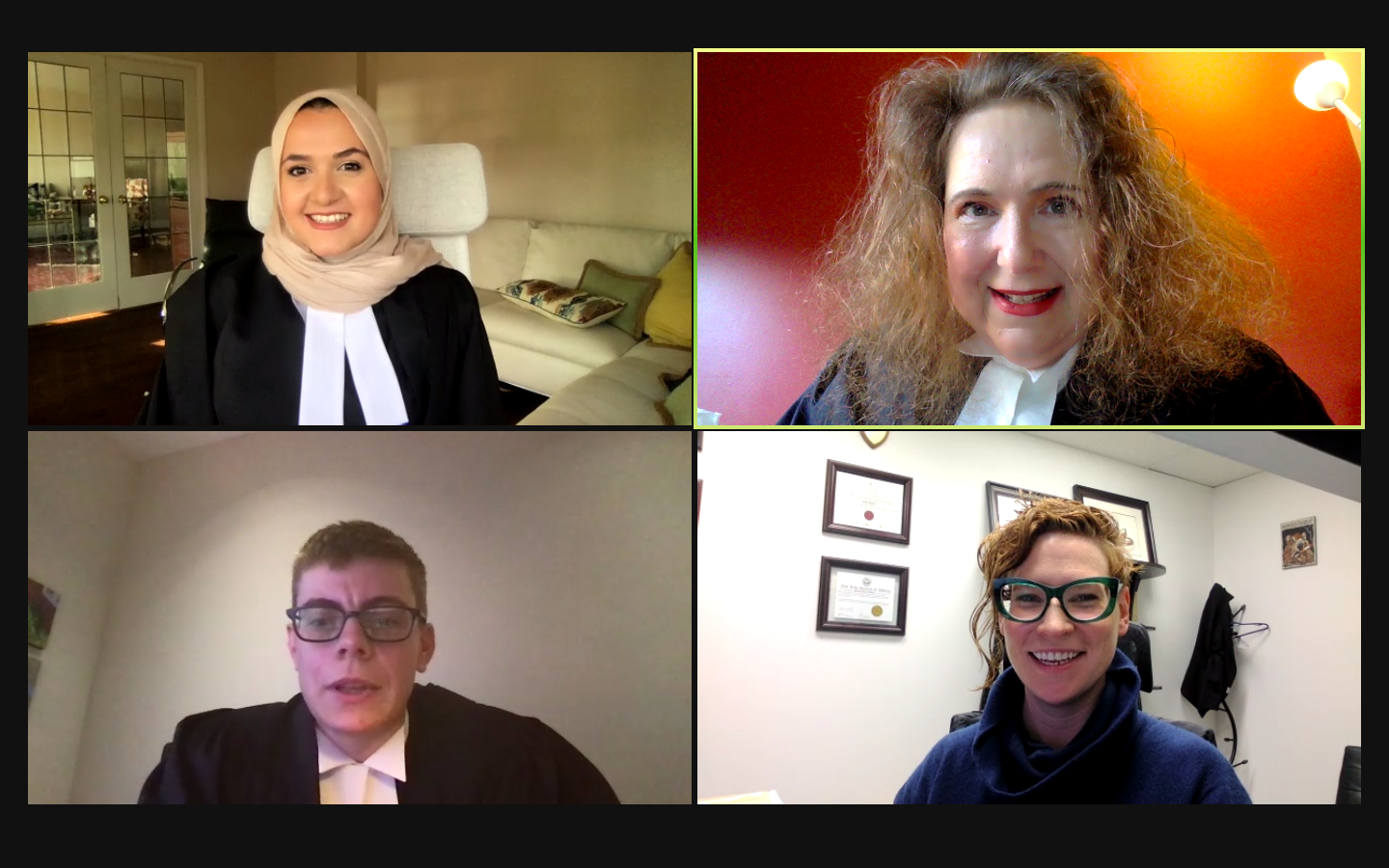
Really encourage everyone to watch the fantastic oral advocacy of Stephanie DiGiuseppe and Danielle Robitaille as well as Carter Martell in Sullivan and Chan here:
The Judgment is OUT! Big Win for our side of the equation and thrilled about this outcome.
Brief Summary here; https://www.scc-csc.ca/case-dossier/cb/2022/39270-eng.aspx
R. v. Sullivan

- Decision
- Date: May 13, 2022
- Neutral Citation: 2022 SCC 19
- Breakdown of the decision:
- On appeal from the Court of Appeal for Ontario
- Case information (39270)
- Webcast of hearing
- Lower court rulings:
- Judgment regarding Mr. Sullivan (Ontario Superior Court of Justice – unreported)
- Judgment regarding Mr. Chan (Ontario Superior Court of Justice)
- Appeal Court of Appeal for Ontario
The Supreme Court confirms a man’s acquittals and the Court of Appeal’s order for a new trial for another man in cases involving automatism.
These cases are about two Ontario men, David Sullivan and Thomas Chan, who committed violent acts while extremely intoxicated from drugs they had voluntary taken. The events are unrelated, but both men argued that the drugs left them in states of “automatism”. Automatism is when someone claims to have been so intoxicated or impaired that they lost complete control of themselves.
Mr. Sullivan took an overdose of a prescription drug, fell into an impaired state and attacked his mother with a knife, gravely injuring her. He was charged with several offences, including aggravated assault and assault with a weapon.
Mr. Chan took “magic mushrooms”, which contain a drug called psilocybin. He fell into an impaired state, attacked his father with a knife and killed him, and seriously injured his father’s partner. Mr. Chan was tried for manslaughter and aggravated assault. In addition to the defence of automatism, he said an underlying brain injury was also to blame for his actions.
Section 33.1 of the Criminal Code prevents a person from using automatism as a defence for crimes involving assault or interference with the bodily integrity of another person. At their respective trials, Mr. Sullivan and Mr. Chan argued that section 33.1 violates sections 7 and 11(d) of the Canadian Charter of Rights and Freedoms (Charter). Section 7 guarantees everyone the right to life, liberty and security of the person, whereas section 11(d) guarantees everyone the right to be presumed innocent until proven guilty.
In Mr. Sullivan’s case, the trial judge accepted that he was acting involuntarily, but said section 33.1 prevented the defence of automatism and convicted him. In Mr. Chan’s case, a different trial judge said he did not have to follow previous decisions of the same court declaring section 33.1 unconstitutional. He also said Mr. Chan’s brain injury was not the cause of his actions. As a result, he convicted Mr. Chan.
Both men appealed to the Ontario Court of Appeal, which heard the appeals together. The Court of Appeal acquitted Mr. Sullivan and ordered a new trial for Mr. Chan since no actual finding of fact had been made about automatism in his case. The Crown then appealed both rulings to the Supreme Court of Canada.
The Supreme Court has dismissed the appeals.
In R. v. Brown, the Supreme Court decided section 33.1 of the Criminal Code was unconstitutional.
Writing for a unanimous Supreme Court, Justice Nicholas Kasirer said the Supreme Court’s ruling in R. v. Brown, which was heard together with these appeals and whose judgment is being rendered at the same time, is applicable to this case. In R. v. Brown, the Court says section 33.1 of the Criminal Code violates sections 7 and 11(d) of the Charter in a way that cannot be justified in a free and democratic society and is unconstitutional. In this case, Mr. Sullivan can be acquitted because he had proven that he was intoxicated to the point of automatism and the trial judge had found he was acting involuntarily. For his part, Mr. Chan can argue the automatism defence at his new trial, Justice Kasirer explained.
The effect of a declaration of unconstitutionality by one trial court on another within the same province
In this case, the Supreme Court also addressed the question of whether a declaration of unconstitutionality by a trial court is binding on other courts within the same province. The Court said a decision is indeed binding on other trial courts, unless the facts are very different or if the court had no practical way of knowing the decision existed.
Cases in Brief are prepared by communications staff of the Supreme Court of Canada to help the public better understand Court decisions. They do not form part of the Court’s reasons for judgment and are not for use in legal proceedings. Date modified:2022-05-13
Read the Full Sullivan and Chan Judgment here:
https://decisions.scc-csc.ca/scc-csc/scc-csc/en/item/19390/index.do
Also fabulous result in R v. Brown, in which the substantive issue of the constitutionality of section 33.1 is addressed fully.
Read the Brown Judgment here:
https://decisions.scc-csc.ca/scc-csc/scc-csc/en/item/19389/index.do
Watch Michelle Biddulph for Mr. Brown and Carter Martell for our client the EC in R v Brown here:


 anitaszigeti